
Key Takeaways
- Act Fast: Mitigation within 24–48 hours prevents mold growth and structural rot.
- Document Everything: Photos and videos are your best leverage during insurance negotiations.
- Verify Credentials: Ensure contractors hold IICRC certification and valid Oklahoma licensing.
- Know Your Policy: “Actual Cash Value” vs. “Replacement Cost” drastically changes your payout.
- Local Expertise Matters: Tulsa’s specific weather patterns require contractors familiar with hail impact and wind-driven rain.
When severe weather strikes Green Country, the aftermath is often chaotic and overwhelming. Understanding the nuances of Storm Damage Restoration in Tulsa Oklahoma is not just about fixing a roof; it is about protecting your largest investment and navigating a complex insurance landscape. This guide provides a step-by-step roadmap to help you move from disaster to recovery with confidence.
The Unique Threat Landscape of Tulsa
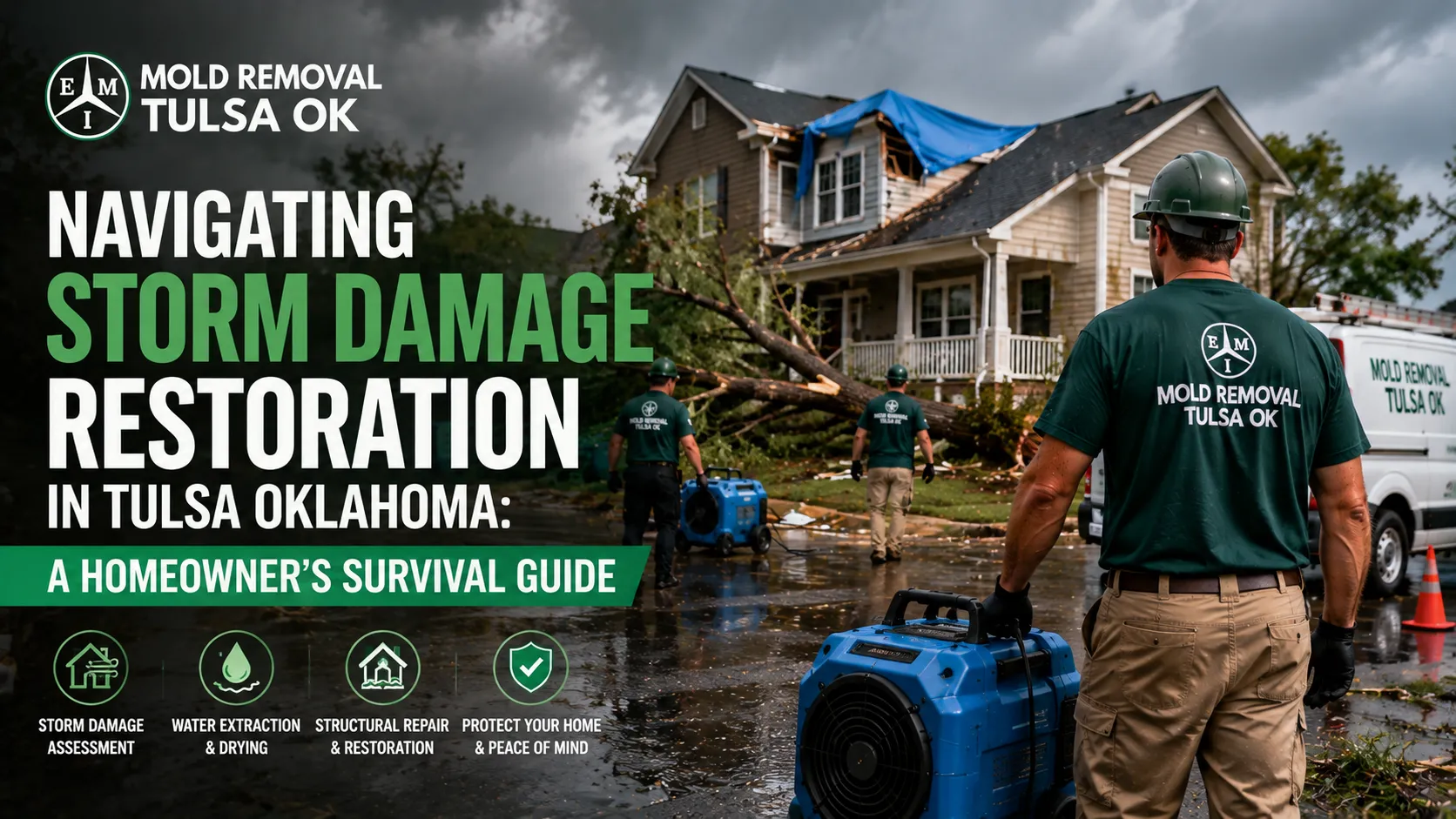
Tulsa sits squarely in “Tornado Alley,” but twisters are only part of the equation. Consequently, homeowners face a triple threat every spring and summer. Furthermore, the region experiences violent supercells capable of producing baseball-sized hail. In addition, straight-line winds frequently exceed 80 mph, peeling back shingles and siding like banana skins. Therefore, a generic restoration approach simply will not suffice for this specific climate.
Hail Damage: The Silent Destroyer
Hail is the most frequent culprit for insurance claims in the 918 area code. Moreover, damage is often invisible from the ground. Granule loss on asphalt shingles exposes the asphalt mat to UV rays, drastically shortening roof life. Consequently, a professional inspection is non-negotiable after any hail event, even if you do not see leaks immediately.
Wind and Tornado Impacts
High winds create uplift forces that break the seal on shingles. As a result, wind-driven rain infiltrates the underlayment and decking. Furthermore, debris impact—tree limbs, fencing, unsecured patio furniture—punctures roofing membranes and shatters windows. Therefore, restoration must address both the building envelope and interior water intrusion simultaneously.
Flash Flooding and Drainage Failures
The Arkansas River watershed and numerous creeks create flash flood risks. Additionally, overwhelmed storm drains back up into basements and crawlspaces. Consequently, Category 3 “black water” contamination requires specialized hazmat protocols that standard carpet cleaning cannot resolve.
Immediate Steps: The First 24 Hours
The clock starts ticking the moment the storm passes. Furthermore, your actions during this window determine the scope of the project and the success of your claim. Therefore, prioritize safety above all else.
Safety and Mitigation
Do not enter a structure with sagging ceilings or standing water near electrical outlets. Moreover, shut off the main breaker if water has reached electrical panels. In addition, tarp damaged roofs and board up broken windows to prevent secondary damage. Consequently, most policies require “reasonable mitigation” to honor the claim.
Documentation Protocols
Walk the property with a smartphone recording video narration. Furthermore, capture wide shots for context and close-ups for detail. In addition, photograph serial numbers on HVAC units and appliances. Therefore, you create an indisputable timeline of the loss condition.
Contacting Your Carrier
Report the loss immediately via the carrier’s app or 800 number. Moreover, request a claim number and the adjuster’s contact info. In addition, ask for a copy of your full policy, specifically the declarations page and endorsements. Consequently, you avoid surprises regarding deductibles or code upgrade coverage later.
Choosing the Right Restoration Partner
Not all contractors are created equal. Furthermore, “storm chasers” flood into Tulsa after major events, offering low prices and disappearing before warranties expire. Therefore, vetting is your primary defense against fraud.
Essential Certifications and Licensing
Look for IICRC (Institute of Inspection Cleaning and Restoration Certification) credentials, specifically WRT (Water Damage Restoration Technician) and ASD (Applied Structural Drying). Moreover, verify a valid Oklahoma Construction Industries Board license for roofing and general construction. In addition, check for manufacturer certifications (GAF Master Elite, CertainTeed ShingleMaster) which extend material warranties. Consequently, these designations prove technical competence.
Local Reputation and Longevity
Ask for a physical Tulsa office address, not just a P.O. Box. Furthermore, request references from jobs completed 12–24 months ago to verify workmanship durability. In addition, check BBB ratings and Google reviews for patterns regarding communication and supplement handling. Therefore, a local track record ensures they will be around to honor the workmanship warranty.
Red Flags to Avoid
- High-pressure sales tactics demanding immediate signature.
- Offers to “waive” or “absorb” your deductible (this is insurance fraud in Oklahoma).
- Lack of Workers’ Compensation and General Liability insurance certificates.
- Unmarked vehicles or out-of-state plates.
The Insurance Claim Process Demystified
Navigating the claim is often more stressful than the storm itself. Furthermore, understanding the terminology levels the playing field. Consequently, you can advocate for a fair settlement.
ACV vs. RCV: Know the Difference
Actual Cash Value (ACV) pays depreciated value—age and wear reduce your check. Moreover, Replacement Cost Value (RCV) pays what it costs to replace with like kind and quality today. In addition, most policies start with an ACV payment, releasing the recoverable depreciation (the difference) only after you submit the final invoice. Therefore, you must front the full cost initially if you have an RCV policy.
The Role of the Public Adjuster
If the carrier’s estimate is significantly lower than local contractor bids, a public adjuster works for you, not the insurance company. Furthermore, they charge a percentage of the settlement (typically 10%). In addition, they are invaluable for complex total losses or disputed scope items. Consequently, hire one only if negotiations stall.
Supplements and Code Upgrades
Initial estimates rarely capture everything. Moreover, hidden damage appears during tear-off. In addition, Tulsa building codes may require ice-and-water shield, drip edge, or decking upgrades not on the original roof. Therefore, a skilled contractor submits supplements with photos and code citations to secure additional funds.
Phases of Professional Restoration
A quality project follows a strict methodology. Furthermore, skipping steps leads to future failures. Consequently, insist on this workflow.
Phase 1: Emergency Mitigation
Water extraction, tarping, board-up, and temporary power. Moreover, antimicrobial application prevents mold amplification. In addition, contents are packed out, inventoried, and stored in climate-controlled facilities. Therefore, the structure is stabilized for the repair phase.
Phase 2: Structural Drying and Monitoring
Industrial dehumidifiers and air movers create a drying chamber. Furthermore, technicians monitor moisture mapping daily using thermal imaging and penetrating meters. In addition, they adjust equipment to hit the “dry standard” (typically within 4 points of unaffected areas). Consequently, this scientific approach validates dryness for the adjuster.
Phase 3: Reconstruction and Build-Back
Roof replacement, siding repair, drywall, paint, flooring, and trim. Moreover, the project manager coordinates trades and inspections. In addition, material selections are finalized with the homeowner. Therefore, the home returns to pre-loss condition—or better, if upgrades are selected.
Preventing Future Loss: Hardening Your Home
Restoration is the perfect time to upgrade resilience. Furthermore, mitigation investments often lower insurance premiums. Consequently, discuss these options with your contractor.
Impact-Resistant Roofing (Class 4)
Class 4 shingles withstand 2-inch steel ball impacts. Moreover, many carriers offer premium discounts of 5–25% for these materials. In addition, they significantly reduce hail claim frequency. Therefore, the upfront cost delta pays for itself over the roof’s life.
Secondary Water Barriers
Peel-and-stick underlayment seals the deck if shingles blow off. Furthermore, this is now code in many coastal and high-wind zones. In addition, it is cheap insurance against wind-driven rain intrusion. Consequently, specify it on every re-roof.
Gutter Guards and Grading
Clogged gutters cause foundation saturation and fascia rot. Moreover, positive grading (slope away from foundation) is the first line of defense against basement water. In addition, French drains or sump pumps handle high water tables. Therefore, exterior water management protects the structure holistically.
Commercial Property Considerations
Business owners face unique pressures: revenue loss, tenant displacement, and code compliance. Furthermore, Business Interruption coverage kicks in only after a “period of restoration” defined in the policy. Consequently, speed is money.
Pre-Loss Planning
Develop an Emergency Ready Profile (ERP) with your restoration vendor. Moreover, this document maps shut-offs, key contacts, and priority areas. In addition, it authorizes immediate mitigation without waiting for ownership approval. Therefore, downtime is minimized.
Large Loss Project Management
Multi-family or commercial projects require dedicated project managers and superintendents. Furthermore, phasing plans allow partial occupancy during repairs. In addition, dust containment and noise control protect remaining tenants. Consequently, specialized commercial experience is non-negotiable.
Understanding Tulsa Permitting and Codes
The City of Tulsa and surrounding municipalities (Broken Arrow, Owasso, Bixby) enforce the 2018/2021 International Codes. Furthermore, roofing permits are required for re-roofs and structural repairs. In addition, inspections (decking, final) are mandatory. Therefore, unpermitted work risks fines and complications during future resale.
Contractor Responsibility
Licensed contractors pull permits in their name. Moreover, they schedule inspections and correct violations. In addition, the Certificate of Occupancy or final permit closure protects the homeowner. Consequently, never pull a “homeowner permit” for a contractor—it shifts liability to you.
Frequently Asked Questions
How long does the typical storm damage restoration process take in Tulsa?
Mitigation takes 3–5 days. Reconstruction varies wildly: a roof replacement is 1–3 days; a full interior rebuild runs 4–12 weeks depending on material lead times and supplement approvals. Complex commercial projects can extend to 6+ months.
Will my insurance rates go up if I file a claim for storm damage?
Oklahoma law prohibits surcharges for “Act of God” claims (wind, hail, tornado) on personal lines policies. However, your claims history follows you (CLUE report). Multiple claims in 3–5 years can trigger non-renewal or difficulty finding new coverage, even without a direct rate hike.
Can I choose my own contractor, or must I use the insurance company’s “preferred vendor”?
You have the absolute right to hire any licensed contractor in Oklahoma. The carrier cannot force you to use their network. Preferred vendors work on volume pricing agreements with the insurer; independent contractors work solely for you, often advocating harder for full scope coverage.
What is “depreciation” on my insurance estimate, and do I get it back?
Depreciation (holdback) is the difference between ACV and RCV. If you have Replacement Cost coverage, you recover this money after repairs are complete and you submit the final invoice. If you have an ACV-only policy, that money is gone forever. Check your declarations page immediately.
How do I know if my roof has hail damage if I don’t see leaks?
Hail causes granule loss and bruising that compromises the shingle’s water-shedding ability long before leaks appear. UV exposure then bakes the exposed asphalt, leading to cracking and failure 12–24 months later. Only a trained eye (or drone inspection) can identify this latent damage safely.
Final Thoughts: Your Recovery Roadmap
Recovering from severe weather is a marathon, not a sprint. Furthermore, the decisions you make in the first week echo for years. Consequently, partner with a local, certified expert who understands Tulsa’s specific challenges. In addition, treat your insurance policy as a contract to be enforced, not a favor to be granted. Therefore, armed with this knowledge, you can restore your property—and your peace of mind—on your terms.
Don’t Face the Aftermath Alone
You need a team that knows Tulsa roofs, Tulsa codes, and Tulsa insurance adjusters. Stop guessing and start restoring.
Call for Free Inspection: (918) 268-5526
24/7 Emergency Response | IICRC Certified | Licensed & Insured in Oklahoma
Helpful resources: For more information, see EPA guidelines on mold and FEMA disaster recovery resources.