When severe weather tears through Green Country, the aftermath can feel overwhelming. If you’re searching for storm damage restoration near me, you need immediate action not endless scrolling through unverified listings. Securing professional help quickly can prevent secondary issues like mold growth, water damage, and structural weakening. This guide cuts through the noise, offering a clear path to reliable experts who understand Tulsa’s unique climate challenges.
Key Takeaways
- Act within 24–48 hours to mitigate water intrusion and prevent microbial growth.
- Verify IICRC certification and Oklahoma contractor licensing before signing any contract.
- Document everything with photos and video before crews begin demolition or drying.
- Choose local experience over national brand names alone; Tulsa building codes and wind patterns are specific.
- Never pay full upfront; reputable firms work with insurance adjusters directly.
Immediate Steps After the Sky Falls
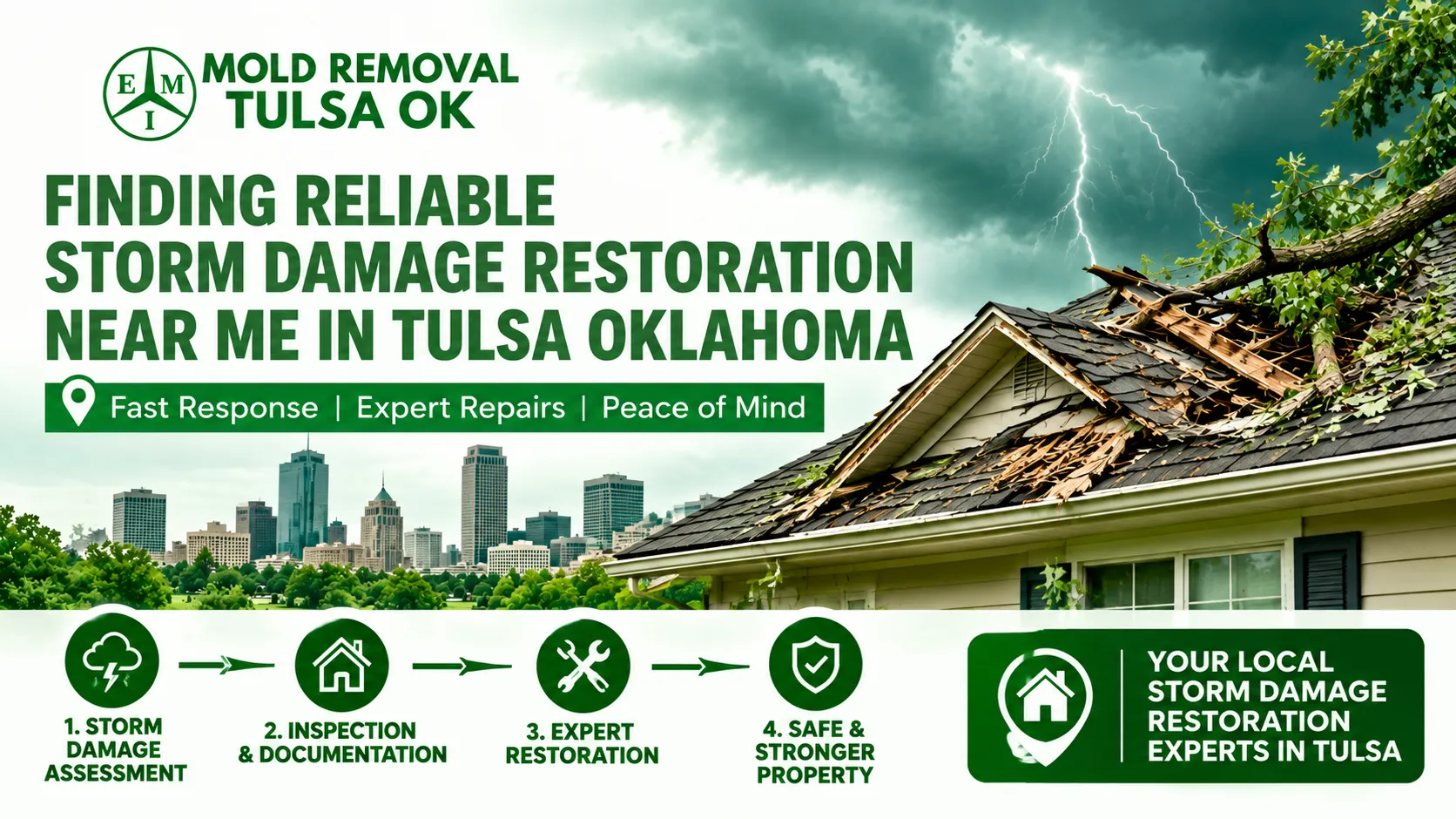
Safety remains the absolute priority once the sirens stop. Downed power lines, compromised gas lines, and unstable structures pose lethal risks. Consequently, do not enter a heavily damaged building until authorities clear it. Furthermore, contact your insurance carrier immediately to open a claim; they often provide a claim number instantly via mobile apps. Meanwhile, tarping a roof or boarding windows constitutes emergency mitigation—most policies require this to prevent further loss. Therefore, keep receipts for any temporary fixes you authorize.
Why Tulsa-Specific Expertise Changes the Outcome
Oklahoma weather behaves differently than coastal hurricanes or northern blizzards. We face violent supercells, massive hail, and straight-line winds exceeding 80 mph. Consequently, restoration crews must recognize hail impact marks on shingles versus simple granule loss. In addition, they need familiarity with Tulsa’s specific building stock—mid-century ranch homes in Midtown react differently to water intrusion than new builds in Broken Arrow or Bixby. Local crews also navigate municipal permitting in Tulsa, Jenks, and Owasso faster than out-of-state storm chasers.
Evaluating Providers: National Franchises vs. Local Contractors
Searching for help yields a mix of national brands and independent firms. Both models work, yet their strengths differ. Therefore, understanding the landscape helps you pick the right partner for your specific loss.
Servpro of Tulsa Metro
This franchise carries massive brand recognition and 24/7 dispatch capability. Their technicians follow strict corporate protocols for drying documentation, which adjusters generally trust. However, you may rotate through different project managers during a large loss. Pricing aligns with industry standard Xactimate rates, though minimum charges apply for emergency calls.
Paul Davis Restoration of Greater Tulsa
Paul Davis emphasizes reconstruction alongside mitigation. This means they handle the tear-out and the rebuild, reducing coordination headaches. Their estimators often have construction backgrounds, leading to more accurate scopes of work. On the downside, their schedule can back up during widespread events because they self-perform carpentry.
Rainbow International of Tulsa
Known for fire and water specialization, Rainbow invests heavily in drying technology like desiccant dehumidifiers for large commercial losses. Their response time is competitive, yet residential clients sometimes report less personalized communication compared to smaller shops. They excel when mold remediation accompanies storm damage.
Local Independent Specialists (e.g., Tulsa Disaster Restoration, Sooner State Restoration)
Owner-operated firms live or die by neighborhood reputation. The owner often manages your project daily. They know Tulsa inspectors by name and adjusters by direct line. Flexibility is high—custom drying plans, weekend work, and direct text access to decision-makers are common. Verify their bonding and workers’ comp certificates carefully, as oversight varies.
Insurance Preferred Vendor Programs
Carriers like State Farm, Farmers, and Oklahoma Farm Bureau maintain “preferred vendor” lists. Using these firms speeds claim approval and often includes workmanship guarantees backed by the insurer. Nevertheless, you retain the legal right to hire anyone; the vendor program cannot be mandatory. Interview the referred company just as rigorously as a cold lead.
Critical Certifications to Verify Before Hiring
Certifications separate professionals from guys with trucks and fans. The Institute of Inspection, Cleaning and Restoration Certification (IICRC) sets the global standard. Look specifically for WRT (Water Damage Restoration Technician) and ASD (Applied Structural Drying) designations. Furthermore, the firm should hold a current Oklahoma Construction Industries Board license for roofing or general contracting if they perform rebuilds. Ask for proof of general liability ($1M minimum) and workers’ compensation insurance. Without these, you become the liable employer if a worker gets hurt on your property.
Navigating Insurance Claims for Wind and Hail Damage
Adjusters work for the carrier, not you. Consequently, having your restoration estimator meet the adjuster on-site levels the playing field. Your contractor reads the policy language, identifies covered perils (wind vs. flood distinction is critical in Tulsa), and ensures code upgrade coverage (Ordinance or Law) gets applied. For example, if decking replacement triggers a full roof deck sheathing upgrade per 2018 IRC codes adopted by Tulsa, the carrier owes that cost. Do not accept the first summary report without your contractor’s review.
Preventative Measures for Future Oklahoma Storm Seasons
Restoration is reactive; resilience is proactive. Impact-resistant Class 4 shingles qualify for insurance premium discounts up to 25% with many Oklahoma carriers. Furthermore, secondary water barriers (peel-and-stick underlayment) stop driven rain when shingles blow off. Trim trees back from the roofline annually—arborists in Tulsa stay booked post-storm, so schedule winter pruning. Finally, install a whole-house surge protector; lightning strikes fry HVAC boards and panels instantly, a loss often capped at $500–$1,000 on standard policies unless endorsed.
How fast should I call a restoration company after a Tulsa storm?
Call immediately—ideally within the first few hours. Most reputable firms offer 24/7 emergency dispatch. Rapid extraction and drying within 24–48 hours drastically reduce the risk of mold colonization, which can start at 72 hours in Oklahoma humidity. Delaying also risks claim denial for “failure to mitigate.”
Will my homeowner’s insurance cover the full cost of storm restoration?
Coverage depends on your specific policy peril inclusions and deductibles. Wind and hail are standard covered perils; flood (rising groundwater) requires a separate NFIP policy. You owe your deductible. Code upgrade coverage (Ordinance/Law) is often an endorsement—verify you have it, as Tulsa building codes frequently require upgrades during repair.
Can I stay in my home during the restoration process?
It depends on the severity. Category 1 (clean water) losses affecting one room often allow occupancy with containment barriers. Category 2/3 (gray/black water) or structural instability usually requires temporary relocation. Your contractor and adjuster will advise; “Loss of Use” coverage on your policy often pays for hotel stays.
What is the difference between mitigation and reconstruction?
Mitigation stops the damage: extraction, drying, tarping, boarding up. Reconstruction puts the home back to pre-loss condition: drywall, paint, flooring, roofing. Some firms do both (full-service); others specialize only in mitigation and hand off to a builder. Clarify which model your chosen firm uses before signing.
How do I avoid storm-chasing scams after a major Tulsa weather event?
Demand a local physical address, Oklahoma CIB license number, and proof of insurance. Never pay large deposits upfront—10% or $1,000 (whichever is less) is standard for materials. Check BBB ratings and Google reviews for sudden review spikes (a red flag). Legitimate local companies have established histories, not PO boxes rented last week.
Don’t Let Storm Damage Derail Your Life
Every hour of delay increases repair costs and health risks. Connect with Tulsa’s most trusted restoration specialists who answer the phone 24/7, work directly with your insurance, and guarantee their workmanship.
Call Emergency Dispatch: (918) 268-5526
Licensed • Insured • IICRC Certified • Tulsa Owned & Operated
Helpful resources: For more information, see EPA guidelines on mold and FEMA disaster recovery resources.