Key Takeaways
- Rapid response is non-negotiable: Every hour of delay increases secondary damage like mold growth and structural weakening.
- Category classification matters: Clean water, grey water, and black water require vastly different safety protocols and disposal methods.
- Documentation drives insurance success: Detailed moisture mapping and photographic evidence streamline claim approvals.
- Local expertise wins: Tulsa’s unique climate and building codes demand contractors familiar with regional humidity and flash-flood risks.
- Business continuity planning reduces downtime: Pre-loss agreements ensure priority service when disaster strikes.
Water intrusion threatens the operational backbone of any enterprise. When pipes burst, roofs leak, or storm drains back up, the clock starts ticking on asset preservation and revenue protection. Professional commercial water damage restoration in Tulsa Oklahoma involves far more than extracting standing water; it requires a systematic approach to structural drying, microbial prevention, and project management tailored to complex commercial environments. Facility managers and business owners must understand the scope, standards, and selection criteria to mitigate loss effectively.
The Unique Challenges of Commercial Water Loss
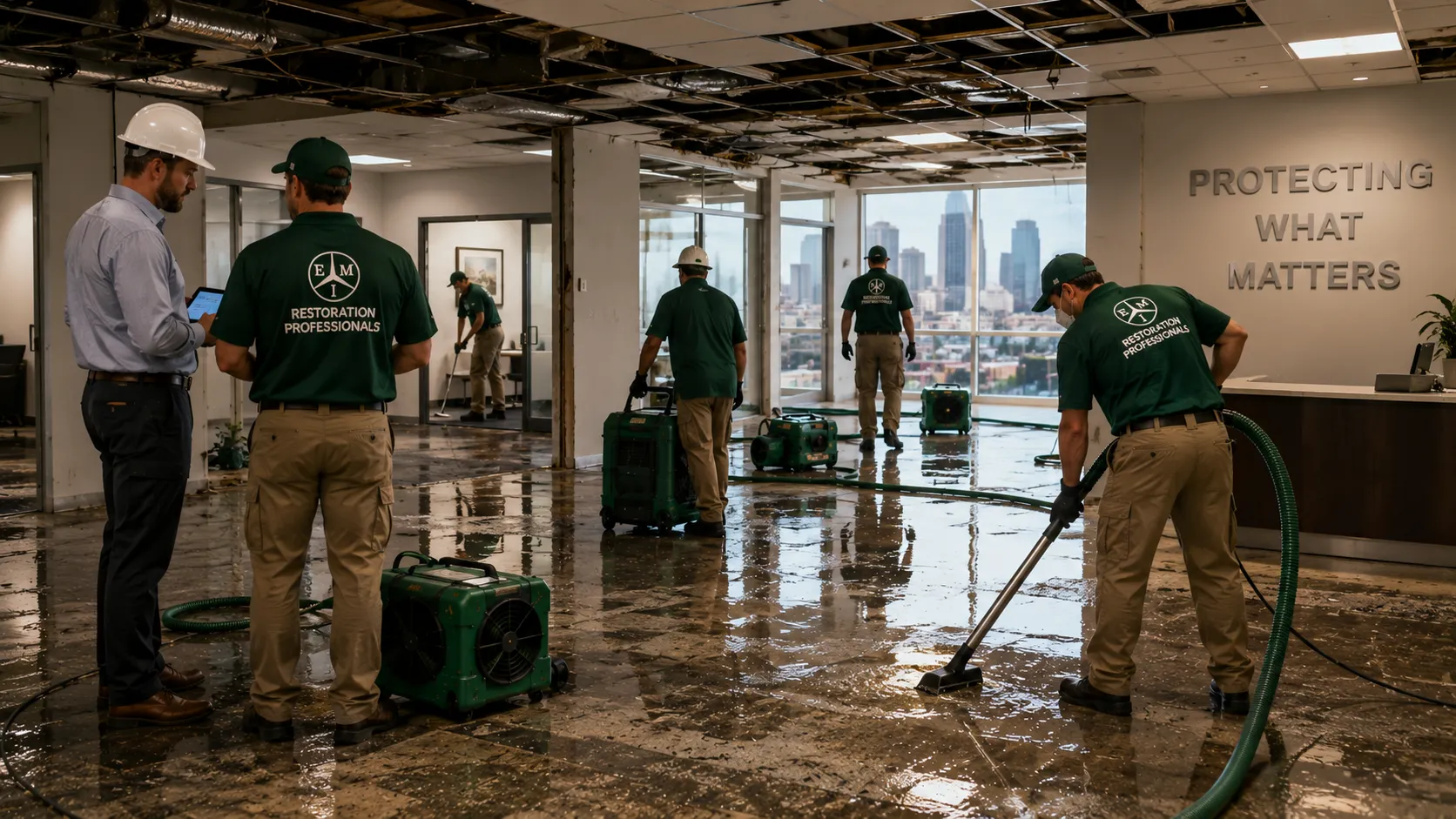
Residential and commercial incidents differ dramatically in scale and complexity. A flooded warehouse involves thousands of square feet of concrete slab, often requiring specialized desiccant dehumidification rather than standard refrigerant units. Furthermore, multi-story office buildings present vertical migration risks where water travels through chases, elevator shafts, and HVAC plenums, affecting tenants several floors below the origin.
Consequently, the logistics of moving heavy equipment, managing tenant displacement, and coordinating with property management firms add layers of project management absent in single-family homes. Downtime equals lost revenue, so restoration contractors must operate in phases, often working nights or weekends to keep critical business functions online. This operational balancing act defines the commercial restoration niche.
Understanding Water Categories and Classes
Category 1: Clean Water Sources
This classification covers sanitary sources like broken supply lines, sink overflows, or rainwater intrusion. While initially safe, Category 1 degrades rapidly. Within 24 to 48 hours, warmth and organic debris transform clean water into a microbial breeding ground. Therefore, speed remains the primary factor in preventing escalation to Category 2.
Category 2: Grey Water Contamination
Grey water contains significant chemical, biological, or physical contaminants. Common commercial sources include dishwasher discharge, washing machine overflow, or sump pump failures. Exposure causes discomfort or sickness. Porous materials like carpet padding and drywall usually require removal because contaminants bind to fibers, making sanitization unreliable.
Category 3: Black Water Hazards
This is grossly unsanitary water containing pathogenic agents. Sewage backups, flooding from rivers (like the Arkansas River during heavy spring rains), and toilet backflows beyond the trap fall here. Category 3 demands full PPE, containment barriers, and disposal of all porous structural materials. Furthermore, specialized antimicrobial treatments and HEPA air scrubbing are mandatory before reconstruction begins.
Class Determinations: Volume and Evaporation Load
Beyond contamination, the IICRC S500 standard classifies losses by evaporation load. Class 1 affects a small area with low porosity materials. Class 2 involves entire rooms with wet carpet and wicking up walls 12–24 inches. Class 3 signifies the greatest volume—ceilings, walls, insulation, and subfloors saturated—often from overhead sprinkler activation. Class 4 denotes specialty drying situations: hardwood floors, plaster, concrete, or deep saturation requiring very low specific humidity.
The Restoration Workflow: From Triage to Reconstruction
Emergency Contact and Rapid Deployment
The process begins the moment a property representative calls a 24/7 dispatch line. Leading Tulsa firms maintain strategically positioned fleets to reach sites within 60 to 90 minutes. Upon arrival, project managers conduct a safety assessment: electrical hazards, structural stability, and asbestos/lead presence in older buildings (pre-1980 construction common in downtown Tulsa).
Inspection, Moisture Mapping, and Documentation
Technicians deploy thermal imaging cameras and penetrating moisture meters to create a moisture map. This map defines the drying boundary, preventing “chasing the water” blindly. Documentation includes psychrometric readings (temperature, relative humidity, grains per pound) logged daily. This data proves to adjusters that drying goals are met scientifically, not arbitrarily.
Water Extraction and Bulk Removal
High-volume extraction removes 97% of free water. Truck-mounted extractors (15–20 HP) outperform portable units significantly, crucial for large retail spaces or industrial floors. Weighted extraction tools compress carpet and pad to pull water from the backing. For hard surfaces, squeegee attachments and vacuum systems prevent water migration into unaffected zones.
Controlled Structural Drying
This phase applies the science of psychrometry. Technicians calculate the required airflow (CFM) and dehumidification capacity (AHAM pints/day) based on cubic footage and material porosity. Air movers create high-velocity airflow across wet surfaces to break the boundary layer, while low-grain refrigerant (LGR) dehumidifiers or desiccants pull moisture from the air. Daily monitoring adjusts equipment placement as materials dry unevenly.
Cleaning, Sanitizing, and Odor Control
Once materials reach dry standards (typically wood <16% MC, drywall <1% MC), HEPA vacuuming removes settled spores. Antimicrobial agents (EPA-registered botanicals or quaternary ammonium compounds) treat affected framing. Hydroxyl generators or ozone treatments (in unoccupied spaces) neutralize volatile organic compounds causing musty odors.
Reconstruction and Build-Back
Full-service contractors transition seamlessly from mitigation to rebuild. This includes drywall hanging, taping, texture matching, painting, flooring installation, and mechanical/electrical/plumbing (MEP) coordination. A single point of contact eliminates the “finger-pointing” common when mitigation and reconstruction firms differ.
Why Tulsa Geography and Climate Amplify Risk
Tulsa sits in a transition zone between humid subtropical and semi-arid climates. Spring brings severe thunderstorms, hail, and tornadoes capable of breaching building envelopes. The Arkansas River basin creates flash-flood vulnerability for riverside industrial parks and the West Tulsa corridor. Conversely, winter freezes rupture fire suppression lines and domestic plumbing in unheated warehouses.
Furthermore, the region’s expansive clay soils shift seasonally, stressing foundation slabs and underground utility penetrations. This geologic movement creates slow leaks at pipe entry points that go undetected for months, rotting sill plates and fostering hidden mold colonies behind baseboards. Local contractors understand these failure patterns intuitively, inspecting perimeter grade beams and French drain functionality during initial assessments.
Selecting the Right Restoration Partner
Certifications and Industry Affiliations
Verify IICRC firm certification and individual technician credentials (WRT, ASD, AMRT). Membership in the Restoration Industry Association (RIA) or local chapters like the Oklahoma Disaster Restoration Association signals commitment to ethical standards. Ask for proof of General Liability, Pollution Liability, and Workers’ Compensation certificates naming your entity as additional insured.
Commercial Capacity and Equipment Depth
Request an equipment inventory list. A legitimate commercial contractor owns—or has immediate rental access to—desiccant dehumidifiers (5,000+ CFM), high-pressure injection drying systems for hardwood, and temporary power distribution (spider boxes, generators). If they rely solely on residential-grade LGRs, they cannot dry a 50,000 sq. ft. facility efficiently.
Pre-Loss Agreements and Priority Response
Sophisticated property managers negotiate Master Service Agreements (MSAs) or Pre-Loss Contracts. These documents lock in pricing (often T&M based on IICRC/RS Means data), establish response time SLAs (e.g., 2-hour on-site), and pre-approve vendor status with insurance carriers. This eliminates procurement delays during a crisis.
Insurance Liaison Expertise
The best firms employ in-house claim specialists or work closely with public adjusters. They speak the language of “Scope of Loss,” “Actual Cash Value vs. Replacement Cost,” and “Code Upgrade Coverage.” Their estimates align with Xactimate or Symbility pricing databases, reducing supplement requests and speeding fund release.
Navigating the Insurance Claim Process
Commercial policies differ vastly from homeowner forms. They often include Business Interruption (BI) coverage, Extra Expense endorsements, and Ordinance or Law coverage for code upgrades. A restoration partner must document mitigation costs separately from reconstruction to maximize BI recovery. Daily drying logs, equipment validation photos, and psychrometric charts become evidence supporting the “period of restoration” calculation.
Furthermore, carriers may invoke “protective preservation” clauses. If the insured fails to mitigate promptly—tarping a roof, boarding windows—the carrier can deny ensuing damage. Immediate contractor deployment satisfies this duty. Additionally, Tulsa’s municipal codes (Title 24 Building Regulations) may require fire-rated assemblies or ADA upgrades during rebuild; Ordinance or Law coverage pays these increments, but only if the estimator identifies them upfront.
Preventative Maintenance and Risk Mitigation
While restoration is reactive, resilience is proactive. Implement a quarterly inspection regime: test sump pumps and backup batteries, inspect roof membranes and flashing, verify HVAC condensate lines flow freely, and exercise isolation valves on sprinkler systems. Install wireless water leak sensors in server rooms, mechanical rooms, and under raised access flooring. These $50 devices alert facility managers via SMS before gallons become thousands of gallons.
Develop a Water Damage Emergency Response Plan (ERP). Map all shut-off valves (domestic, fire, process), label electrical panels, and maintain a vendor contact list with 24/7 numbers. Conduct tabletop exercises annually with security, engineering, and tenant coordination teams. Preparedness turns a potential catastrophe into a manageable incident.
Advanced Drying Technologies for Complex Assets
Desiccant Dehumidification for Dense Materials
Conventional refrigerant dehumidifiers lose efficiency below 70°F or 40% RH. Desiccants use silica gel or lithium chloride wheels to absorb moisture at any temperature, delivering air at 5% RH or lower. This capability is essential for drying dense concrete slabs, gymnasium hardwood floors, or archival document storage where low vapor pressure drives diffusion from material cores.
Injectidry and Directed Heat Drying
Wall cavity drying systems inject dry air behind baseboards through small ports, saving drywall. Directed heat drying (using electric or propane heaters with high-velocity airflow) accelerates evaporation in Class 4 scenarios. However, heat drying requires strict monitoring to avoid secondary damage like warping millwork or delaminating adhesives. Only trained ASD (Applied Structural Drying) technicians should manage these protocols.
Document and Electronics Recovery
Commercial losses often involve critical records, server rooms, or specialized machinery. Vacuum freeze-drying (lyophilization) salvages wet documents by sublimating ice directly to vapor. For electronics, ultrasonic cleaning with deionized water and corrosion inhibitors recovers circuit boards if processed before oxidation advances. Partner with a contractor offering these niche services in-house or via vetted subcontractors.
Environmental Health and Safety Compliance
OSHA regulations (29 CFR 1910 and 1926) govern worker protection during restoration. Confined space entry permits apply to crawlspaces and manholes. Hazard communication (HazCom) requires Safety Data Sheets (SDS) for all antimicrobials on-site. If asbestos-containing material (ACM) or lead-based paint (LBP) is disturbed during demo, Oklahoma DEQ regulations mandate licensed abatement contractors. A reputable firm halts work immediately upon discovering suspect materials, arranges third-party testing, and coordinates abatement before resuming drying.
Indoor Air Quality (IAQ) protection protects occupants in adjacent unaffected areas. Negative pressure containment with HEPA filtration prevents cross-contamination. Post-remediation verification (PRV) by an independent Industrial Hygienist (CIH or CIEC) provides clearance certificates, defending against future liability claims from tenants or employees.
Cost Factors and Budgeting Expectations
Commercial restoration pricing follows Time & Materials (T&M) or Unit Price models. Mitigation averages $4.00–$7.00 per square foot for extraction and drying, but varies wildly with category, class, and accessibility. Reconstruction runs $15–$40+ per square foot depending on finishes (Class A office vs. warehouse). Specialty items—cleanroom restoration, historic preservation, data center raised floor—command premiums.
Hidden costs include: temporary power rental, dumpster fees (construction debris vs. hazardous waste), equipment rental overruns if drying extends, and project management fees (10–20% of direct costs). Transparent contractors provide daily cost accrual reports. Insist on a “Not-to-Exceed” estimate for the mitigation phase, with change orders required for scope additions.
Business Continuity: The Ultimate Metric
The true measure of restoration success is not dry standards met, but business operations restored. Phased containment allows a call center to operate on Floor 2 while Floor 3 dries. Temporary modular offices or “swing space” leases keep staff productive. Cloud-based data recovery and VoIP phone forwarding maintain client communication. Discuss continuity strategies during the initial scoping meeting; the best contractors think like COOs, not just tradespeople.
Frequently Asked Questions
How fast must water extraction begin to prevent mold in a commercial building?
Extraction should begin within the first 24 hours, ideally within 4–6 hours of discovery. Mold germination can start at 24–48 hours on porous materials. Rapid bulk water removal drops humidity below the threshold required for spore activation, dramatically reducing remediation scope and cost.
Does commercial insurance cover business interruption during water damage restoration?
Yes, most commercial property policies include Business Interruption (BI) coverage. It reimburses lost net income and continuing operating expenses (payroll, rent) during the “period of restoration.” Accurate daily documentation of drying progress by your contractor is critical to substantiate the BI claim duration with the adjuster.
Can wet drywall be saved in a commercial office, or must it be replaced?
Category 1 water on drywall dried within 48 hours can often be saved using in-place drying techniques (injectidry systems). However, Category 2 or 3 contamination, insulation saturation, or delays beyond 72 hours typically mandate removal. Fire-rated assemblies in commercial corridors require strict adherence to UL listings; partial replacement may compromise the rating.
What certifications should I verify before hiring a Tulsa restoration company?
Require IICRC Firm Certification plus individual technician certifications in Water Damage Restoration (WRT), Applied Structural Drying (ASD), and Commercial Drying Specialist (CDS) if available. Verify Oklahoma Construction Industries Board licensing for any reconstruction work. Request current Certificates of Insurance (COI) with General Liability ($1M+), Pollution Liability, and Workers’ Comp.
How does the Arkansas River flood risk affect restoration planning for Tulsa businesses?
Properties in the 100-year floodplain (Zone AE) face Category 3 black water contamination during overtopping events. Restoration plans must include pre-identified staging areas above Base Flood Elevation (BFE), contracted hazardous waste haulers, and engineers for foundation scour inspection. FEMA/NFIP claims run parallel to private insurance, requiring separate documentation protocols.
Don’t Let Water Halt Your Operations
Every minute of downtime impacts your bottom line. Partner with a Tulsa-based team that brings industrial capacity, insurance fluency, and local climate expertise to your recovery.
Call 24/7 Emergency Dispatch: (918) 268-5526
Pre-loss agreements available • IICRC Certified • Direct Insurance Billing
Helpful resources: For more information, see EPA guidelines on mold and FEMA disaster recovery resources.