Disaster strikes without warning, leaving Tulsa homeowners scrambling to find a reliable restoration company in Tulsa Oklahoma that can mitigate damage fast. Whether you are dealing with a burst pipe in midtown, storm damage in Broken Arrow, or fire aftermath near Cherry Street, the speed and competence of your contractor determine whether you recover in weeks or months. This guide cuts through the marketing noise, comparing the major providers serving the metro area and giving you the exact criteria to vet them before you sign a contract.
Key Takeaways
- Response Time is Non-Negotiable: Top Tulsa firms guarantee 60–90 minute arrival for water emergencies to prevent mold colonization.
- IICRC Certification is the Baseline: Verify Institute of Inspection Cleaning and Restoration Certification for every technician on your job site.
- Insurance Fluency Saves You Money: The best contractors negotiate directly with adjusters using Xactimate, reducing your out-of-pocket costs.
- Local Knowledge Matters: Tulsa’s expansive clay soil and severe weather patterns require specific structural drying and foundation expertise.
- Franchise vs. Independent: National brands offer scale; local firms often provide more personalized project management.
Understanding the Tulsa Restoration Landscape
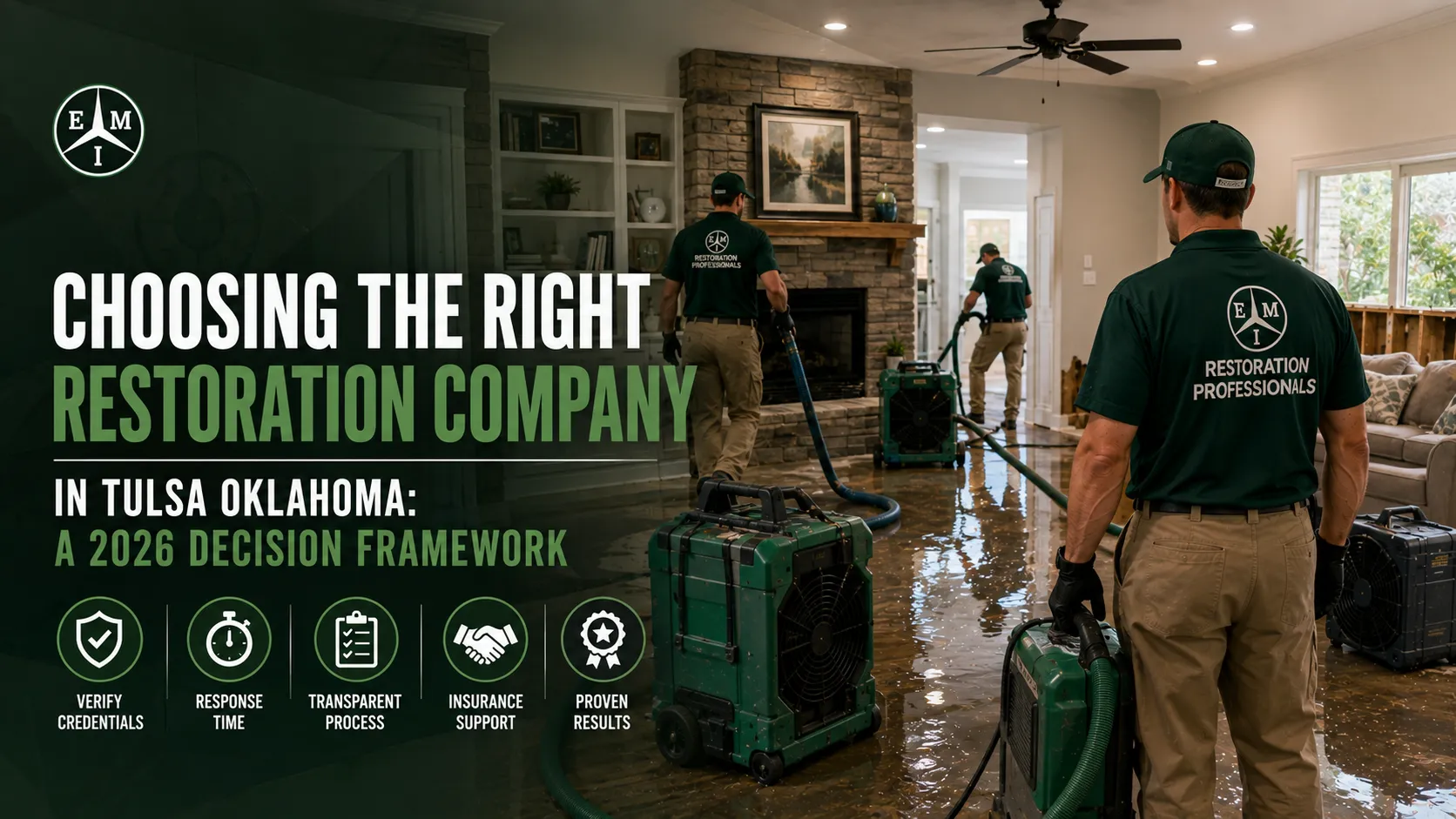
Tulsa sits in a unique geological and meteorological crossroads. Consequently, the demand for property recovery services here is distinct from other markets. The region experiences violent spring storms, flash flooding along the Arkansas River basin, freezing winter pipe bursts, and the ever-present risk of wildfire smoke infiltration. Therefore, a generic contractor simply will not suffice. You need a specialist who understands how Oklahoma’s red clay expands and contracts, shifting foundations and cracking slabs after water intrusion.
Furthermore, the local market is split between large national franchises and deeply rooted family-owned businesses. Both models have distinct advantages. Franchises bring standardized training, massive equipment inventories, and 24/7 dispatch centers. Conversely, local owners often live in the neighborhoods they serve, offering a level of accountability and flexibility that corporate structures sometimes lack. Your choice depends entirely on the complexity of your loss and your communication preferences.
Comparing Major Providers Serving the Tulsa Metro
Below is a comparison of five major restoration entities actively serving the Tulsa, Broken Arrow, Owasso, and Bixby areas. This analysis is based on franchise standards, public certifications, and typical service scopes. Individual franchisee performance varies, so treat this as a starting framework for your interviews.
1. Servpro of Tulsa / South Tulsa County
As the industry giant, Servpro leverages a massive national footprint. Their Tulsa franchises typically maintain large fleets of desiccant dehumidifiers and thermal imaging cameras. They excel at large-loss commercial projects and catastrophic storm response because they can pull resources from neighboring states within hours. Their proprietary “Emergency Ready Profile” app helps commercial clients pre-plan for disasters. However, some residential clients report high technician turnover, meaning the estimator you meet may not be the project manager overseeing daily drying logs.
2. Paul Davis Restoration of Greater Tulsa
Paul Davis positions itself as a “full-service” provider, meaning they handle both mitigation (drying, boarding up) and reconstruction (drywall, paint, flooring) in-house. This single-source model eliminates the friction between the mitigation crew and the build-back crew—a common pain point in insurance claims. Their technicians are typically IICRC Master Water Restorers. The trade-off? Their reconstruction estimates can run higher than independent builders, so scrutinize the line items in your Xactimate estimate carefully.
3. ServiceMaster Restore by DSI (Disaster Specialists, Inc.)
ServiceMaster DSI has a long-standing presence in Oklahoma. They are known for a strong focus on biohazard and trauma cleanup alongside standard water and fire restoration. This makes them a go-to for complex losses involving sewage backups (Category 3 water) or unattended deaths. Their training program is rigorous, often exceeding franchise minimums. Availability can be tighter during widespread freeze events because their local fleet size is smaller than the national giants.
4. PuroClean of Tulsa (The “Paramedics of Property Damage”)
PuroClean differentiates itself through a science-first marketing angle, emphasizing the “psychrometrics” of drying. Their Tulsa franchisees often invest heavily in advanced moisture mapping technology, like FLIR cameras and moisture meters with data logging. They are particularly strong on mold remediation protocols, adhering strictly to IICRC S520 standards. Because they are a slightly smaller franchise system, the owner is frequently on-site, which many homeowners find reassuring during stressful losses.
5. Reset Restoration (Locally Owned & Operated)
Representing the high-end independent sector, Reset Restoration is a Tulsa-native company. They compete by offering white-glove project management. The owner typically manages the job personally, coordinating directly with your insurance adjuster and any third-party contractors (like plumbers or roofers). They do not have the overhead of franchise fees, which can sometimes translate to more aggressive pricing on the reconstruction side. Their capacity for massive commercial losses is lower than Servpro, but for high-value residential claims, their attention to detail is often superior.
Critical Services Every Top-Tier Firm Must Provide
Regardless of the logo on the truck, any firm you hire must demonstrate competency across these four core pillars. If a contractor cannot articulate their process for each, keep looking.
Water Damage Mitigation & Structural Drying
This is the bread and butter of the industry. In Tulsa, slab-on-grade construction is common. Water migrates under vinyl plank, tile, and hardwood, trapping moisture against the concrete. A competent crew uses in-place drying systems (injectidry) to save flooring rather than ripping it out automatically. They must monitor humidity ratios and specific humidity daily, not just “check the equipment.” Ask for their daily psychrometric logs; professionals keep them, amateurs guess.
Fire & Smoke Damage Remediation
Tulsa fires range from kitchen grease fires to wildfire smoke drift. Protein fires (burnt meat) leave an invisible, rancid residue that requires specialized hydroxyl generators or ozone chambers—not just “cleaning.” Soot webs in corners indicate high-heat synthetic fires needing HEPA vacuuming and chemical sponging before any sealing or painting. Verify they subcontract textile restoration (clothes, rugs) to certified Esporta or Fireline facilities rather than sending them to a standard dry cleaner.
Mold Remediation (IICRC S520 Compliance)
Oklahoma humidity makes mold a 12-month threat. Legitimate remediation requires containment (poly barriers), negative air pressure (AFDs), and PPE. Beware of “spray and pray” contractors who just fog antimicrobial and leave. The source of moisture must be fixed first. Post-remediation verification (PRV) by a third-party industrial hygienist is the gold standard; the restoration company should welcome this oversight, not resist it.
Storm & Catastrophe Response
When a derecho hits Tulsa or a hailstorm pounds Jenks, “storm chasers” flood the market. They knock on doors, demand large upfront deposits, and vanish. Legitimate local companies have established physical addresses, Oklahoma contractor license numbers (verify via CIB), and references from 2023 storms. They understand Oklahoma Insurance Department regulations regarding “Assignment of Benefits” forms. Never sign an AOB without legal review.
The Tulsa Factor: Local Challenges Requiring Local Expertise
Why does geography matter so much? Tulsa’s specific environment dictates the technical approach.
Expansive Clay Soils & Foundation Movement
The “Red Dirt” is famous for a reason. It swells when wet and shrinks when dry. A water loss that saturates the perimeter of a slab foundation can cause heaving. Conversely, aggressive structural drying (pulling moisture out of the slab too fast) can cause settlement cracks. Experienced Tulsa restorers coordinate with structural engineers before setting drying goals for slab-on-grade homes. They know that saving the hardwood floors is pointless if the slab cracks and the house shifts.
Severe Weather Patterns
We live in “Tornado Alley” and “Hail Alley.” Roof damage leads to water intrusion. A restoration company here must have established relationships with reputable local roofers. They should know the difference between cosmetic hail damage and functional damage that breaches the decking. They also understand the “wind-driven rain” exclusion clauses in many Oklahoma policies and how to document damage to support coverage.
Aging Housing Stock & Asbestos/Lead
Midtown, Brookside, and Kendall-Whittier neighborhoods feature beautiful 1920s–1950s homes. Disturbing plaster, floor tile mastic, or popcorn ceiling texture during demolition triggers EPA RRP (Renovation, Repair, and Painting) rules and Oklahoma DEQ asbestos regulations. Any restoration company working in these zones must be EPA Lead-Safe Certified and have an asbestos abatement plan or licensed subcontractor ready. Failure here results in massive fines and health liability.
Vetting Checklist: 10 Questions to Ask Before Hiring
Print this list. Call three companies. Compare answers. The differences will be stark.
- “Are your technicians IICRC certified in the specific category of my loss (WRT, FSRT, AMRT)?” Ask for card numbers.
- “Do you use Xactimate for estimating, and will you negotiate supplements with my adjuster?” If they say “we just take what insurance pays,” they are leaving money on the table.
- “What is your protocol for Category 3 (sewage) water?” Look for: containment, PPE, porous material removal, antimicrobial application, third-party clearance.
- “Can you provide a Certificate of Insurance (COI) naming me as Additional Insured?” General Liability ($1M min), Workers Comp, Pollution Liability (critical for mold).
- “Who is my dedicated Project Manager, and what is their cell number?” You need one point of contact, not a call center.
- “Do you perform reconstruction/build-back, or do you subcontract it?” Neither is wrong, but accountability differs. Get the subcontractor’s name and license if subbed.
- “How do you handle contents/personal property?” On-site cleaning? Pack-out to climate-controlled warehouse? Inventory management software?
- “What is your drying goal documentation process?” They should reference target EMC (Equilibrium Moisture Content) of unaffected materials, not arbitrary “3 days of drying.”
- “Are you licensed by the Oklahoma Construction Industries Board (CIB)?” Verify the number online. Restoration often requires a Roofing or Residential Specialty license for build-back.
- “Can I speak to three clients from the last 90 days with similar losses?” Call them. Ask about communication, cleanliness, and supplement handling.
Navigating the Insurance Claim Maze
The restoration company is your advocate, but they work for you, not the insurance carrier. However, they must speak the carrier’s language: Xactimate. This software dictates pricing for every line item (tear out wet drywall, apply antimicrobial, HEPA vacuum). Disputes arise over “scope” (what needs doing) and “price” (what it costs).
A high-quality Tulsa restoration firm employs or contracts an estimator certified in Xactimate (Level 3 preferred). They write the initial scope, the adjuster reviews it, and gaps appear. The contractor then writes “supplements” with photos, moisture logs, and code citations (e.g., “Oklahoma Uniform Building Code requires R-13 insulation in 2×4 walls”). Without this expertise, you pay the difference. Ask potential hires: “What was your supplement approval rate last quarter?” A rate above 80% signals a sharp estimator.
Red Flags: Spotting the “Storm Chasers” and Low-Ballers
After the June 2023 storms, Tulsa saw an influx of out-of-state crews. Protect yourself by watching for these warning signs:
- High-Pressure Sales: “Sign tonight or we pull the crew.” Legitimate companies are busy; they don’t beg.
- Large Upfront Cash Demands: Standard is 0% down for insurance work (they bill the carrier) or 10–33% for self-pay. 50%+ down is a flight risk.
- Unmarked Vehicles / Out-of-State Plates: Local reputation is their asset. No local address = no accountability.
- “We’ll Cover Your Deductible”: This is insurance fraud in Oklahoma. It inflates the claim illegally. Run.
- No Written Contract / Scope of Work: Verbal agreements are worthless. Every line item, timeline, and payment term must be on paper.
Immediate Steps When Disaster Hits (The First 24 Hours)
Action in the first hour dictates the total cost. Follow this protocol:
- Safety First: Shut off power if water threatens panels. Evacuate if structural collapse or gas leak is suspected.
- Stop the Source: Turn off the main water valve. Tarping a roof? Only if safe. Otherwise, wait for pros.
- Document Everything: Video walkthrough before anything moves. Narrate the damage. Open closets, cabinets, drawers. This is your evidence for coverage disputes.
- Call Your Top-Vetted Company: Not your agent first. The mitigation contractor secures the property. Then call the agent to open the claim.
- Mitigate Further Damage: Move valuables to dry areas. Punch weep holes in sagging ceilings to drain water. Pull wet carpet pad (save carpet if clean water).
- Secure the Property: Board-ups for fire/storm. Fencing for pools/hazards. This is a policy condition (“Duties After Loss”).
The Reconstruction Phase: From Demo to Done
Mitigation (drying/cleaning) takes 3–7 days. Reconstruction takes weeks or months. This is where projects stall. If your restoration company handles build-back, demand a Gantt chart schedule with material lead times (cabinets, special-order tile, windows). If they subcontract, meet the General Contractor before mitigation ends. Verify they pull permits for structural, electrical, and mechanical work. Tulsa County and City of Tulsa inspections are mandatory; skipping them voids insurance and creates liability at resale.
Material selection is your moment to upgrade. Insurance pays “Like Kind and Quality” (LKQ). If you had builder-grade carpet, they pay for builder-grade. You pay the delta for hardwood. A transparent contractor presents this “upgrade sheet” clearly, so there are zero surprises at final invoice.
Cost Factors & Budget Realities
Every loss is unique, but understanding pricing drivers helps you audit the estimate.
- Water Category: Cat 1 (Clean) ~$3.50–$5.00/sq ft mitigation. Cat 2 (Grey) ~$5.00–$7.00. Cat 3 (Black/Sewage) ~$7.00–$12.00+ due to PPE, disposal, and antimicrobial.
- Affected Area: Open floor plans dry faster than chopped-up rooms with cabinets.
- Materials: Hardwood drying (tenting) costs 3x carpet removal. Plaster takes longer than drywall.
- Accessibility: Crawlspaces in Tulsa pier-and-beam homes add labor. High ceilings (vaulted) require scaffolding.
- Mold Discovery: Adds containment, hygiene fees, and PRV testing ($1,500–$3,000 typically).
Reconstruction runs $150–$350+/sq ft in Tulsa currently depending on finishes. Get a fixed-price contract for build-back, not “cost-plus,” unless the scope is truly undefined.
Why Speed Without Precision Fails
Some companies brag about “fast drying.” They crank heat and air movers to hit arbitrary day-3 targets. This causes secondary damage: warped hardwood, cracked crown molding, popped drywall nails, and—critically in Tulsa—slab curl. Precision drying balances vapor pressure differentials. It takes longer (often 5–7 days for dense materials) but preserves the structure. Ask for their “Drying Plan” document. If they don’t have one written for your specific job, they are guessing.
Frequently Asked Questions
How quickly should a restoration company arrive after I call in Tulsa?
For emergency water intrusion, the industry standard and top Tulsa providers target a 60-to-90-minute on-site arrival, 24/7/365. For non-emergency assessments (mold inspection, fire estimate), expect scheduling within 24–48 hours. Always confirm the ETA when you call; if they cannot commit to a window, call the next firm on your list.
Will my insurance company force me to use their “preferred vendor”?
No. Oklahoma law (and most policy language) explicitly protects your right to choose any licensed contractor. Insurers have “Preferred Vendor Programs” (like State Farm’s Select Service or Allstate’s Contractor Connection) which offer the insurer warranty guarantees and discounted rates. You can use them, but you are not required to. A non-preferred vendor often advocates harder for you because they don’t rely on the insurer for referral volume.
What certifications should I verify for a Tulsa restoration technician?
The baseline is IICRC (Institute of Inspection Cleaning and Restoration Certification). For water, look for WRT (Water Damage Restoration Technician) or ASD (Applied Structural Drying). For fire, FSRT (Fire & Smoke Damage Restoration Technician). For mold, AMRT (Applied Microbial Remediation Technician). Master designations (Master Water Restorer, Master Fire Restorer) indicate advanced experience. Verify cards at IICRC.org.
How long does a typical water damage restoration take in a Tulsa home?
Mitigation (drying/cleaning) typically takes 3 to 7 days. Reconstruction (repairs) ranges from 2 weeks for a single-room bath leak to 6+ months for a whole-house flood or fire rebuild. Tulsa supply chain lead times for cabinets, appliances, and specialty flooring currently drive the reconstruction timeline more than labor availability.
What happens if I find mold during the restoration process?
Work stops immediately in the affected area. The contractor isolates the zone (containment) and notifies you and the adjuster. A protocol is written (often by a third-party hygienist). Remediation follows IICRC S520. Post-remediation verification (clearance testing) occurs before reconstruction resumes. Insurance coverage for mold varies wildly; review your “Fungi, Wet Rot, Dry Rot” endorsement limits.
Final Verdict: Making the Call
Selecting a restoration partner in Tulsa is a high-stakes decision made under duress. The winning formula combines IICRC technical rigor, Xactimate estimating fluency, local geological awareness, and transparent communication. Do not default to the first name on Google Maps or the adjuster’s “suggestion.”
Interview three firms using the checklist above. Verify their Oklahoma CIB license and pollution liability insurance. Check their Google reviews for responses to negative feedback—professional owners reply with solutions, not excuses. Whether you choose a national franchise like Servpro or Paul Davis for their scale, or a local leader like Reset Restoration for their boutique service, the company that documents the science, communicates the schedule, and negotiates the supplements is the one that gets your life back to normal.
Ready to Secure Your Property?
Don’t wait for the next storm to vet your team. Download our free Tulsa Restoration Vetting Checklist & Emergency Contact Card—designed to stick on your fridge for the moment disaster strikes.
Helpful resources: For more information, see EPA guidelines on mold and FEMA disaster recovery resources.