When disaster strikes your home, every minute counts. Whether you are dealing with a burst pipe in mid-July or smoke damage after a kitchen fire, finding reliable Restoration Services Near Me in Tulsa Oklahoma becomes an immediate priority. You need a team that arrives fast, communicates clearly, and restores your property to its pre-loss condition without adding stress to an already chaotic situation. This guide cuts through the noise, offering a clear roadmap to vetting local experts, understanding the mitigation process, and making the right call for your specific emergency.
Key Takeaways
- Speed is critical: Water damage mitigation must begin within 24–48 hours to prevent mold growth.
- Certifications matter: Look for IICRC-certified firms (WRT, ASD, FSRT) rather than general contractors.
- Local presence wins: Tulsa-based crews navigate local permit offices and insurance adjusters faster than out-of-town franchises.
- Full-service capability: Choose a company that handles mitigation, reconstruction, and contents cleaning under one roof.
- Insurance liaison: The best providers bill your carrier directly and advocate for your full coverage.
Understanding the Scope: What Tulsa Restoration Companies Actually Do
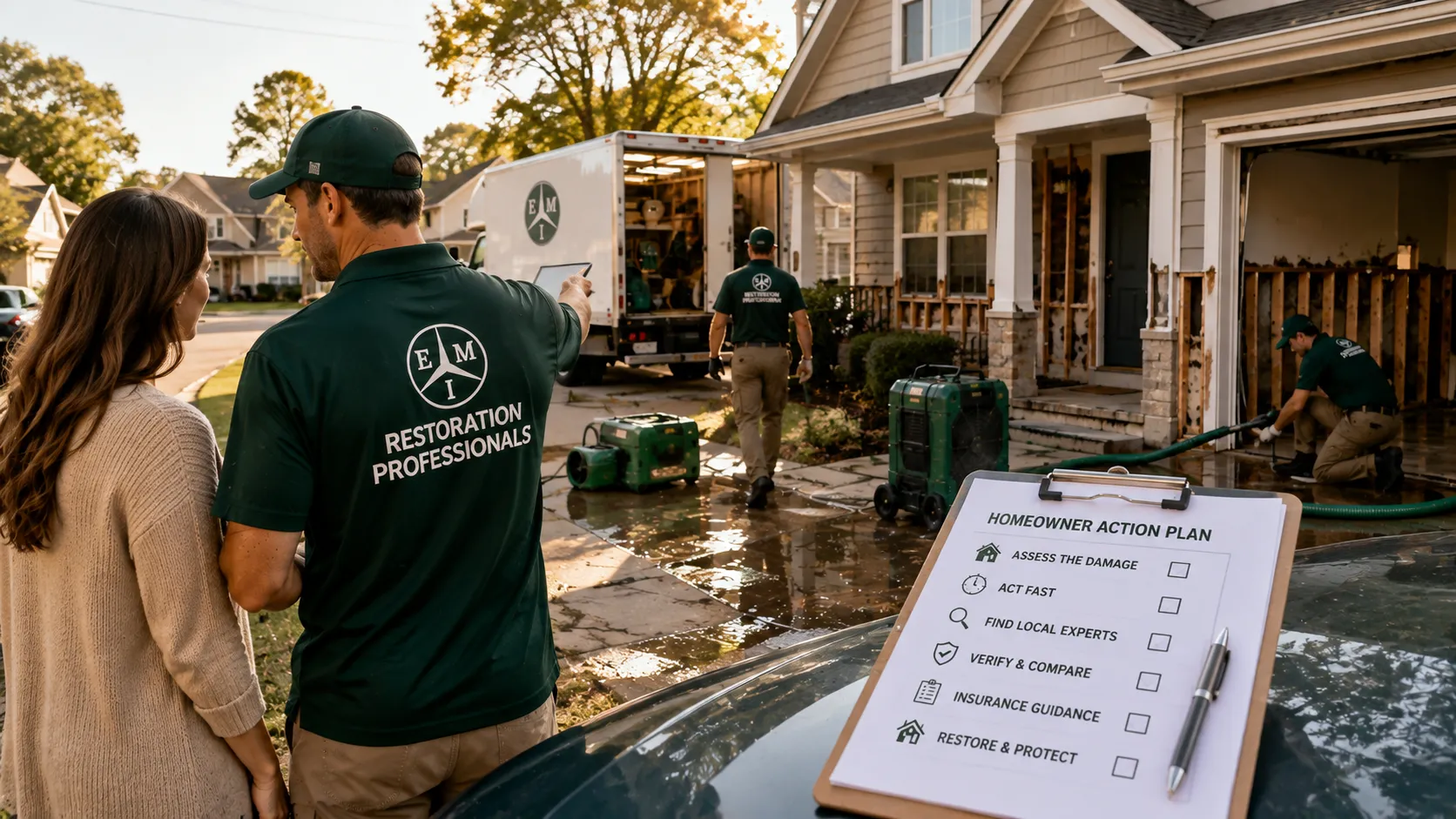
Many homeowners confuse general remodeling with disaster restoration. The difference is massive. Remodelers work on your timeline; restoration professionals work on the disaster’s timeline. Furthermore, restoration involves specialized science—psychrometrics for drying, HEPA filtration for air quality, and antimicrobial treatments for sanitation. Consequently, hiring a painter to fix water-stained drywall often leads to hidden mold behind the walls six months later.
Water Damage Mitigation & Structural Drying
This is the most common call in the Tulsa metro area. From flash flooding near the Arkansas River to frozen pipe bursts in January, water migration is aggressive. Certified technicians use thermal imaging cameras to find moisture inside wall cavities and under subfloors. Subsequently, they deploy commercial-grade dehumidifiers and high-velocity air movers to hit specific drying goals (usually a target moisture content of 10–16% for wood). Therefore, “drying it with fans” is not a strategy; it is a liability.
Fire & Smoke Damage Remediation
Fire damage is complex because it combines structural char, corrosive soot residues, and pervasive odor. Proteins from burnt food create a nearly invisible film that discolors paint and corrodes metal fixtures if not removed with specific alkaline cleaners. In addition, HVAC systems must be cleaned to prevent re-contaminating the living space every time the furnace kicks on. A proper Tulsa fire restoration firm will manage the board-up, the pack-out of salvageable contents, and the structural cleaning simultaneously.
Mold Remediation & Indoor Air Quality
Oklahoma humidity creates a perfect incubator for microbial growth. Legitimate remediation follows IICRC S520 standards: containment under negative pressure, HEPA air scrubbing, physical removal of porous materials, and post-remediation verification (clearance testing) by a third-party hygienist. Be wary of companies that simply spray bleach and paint over it; that is encapsulation, not remediation, and it fails quickly in our climate.
Critical Criteria for Vetting Local Providers
Before you sign a work authorization, run the company through this checklist. Transitioning from panic to protocol protects your wallet and your property value.
IICRC Certification & Ongoing Training
The Institute of Inspection, Cleaning and Restoration Certification is the industry gold standard. Verify the firm holds a current certification, not just an employee. Ask for their specific designations: Water Damage Restoration Technician (WRT), Applied Structural Drying (ASD), Fire & Smoke Restoration Technician (FSRT), and Applied Microbial Remediation Technician (AMRT). Moreover, ask when their last continuing education class was; techniques and equipment evolve rapidly.
Licensing, Insurance, & Bonding in Oklahoma
Oklahoma does not have a state-level “restoration license,” but the Oklahoma Construction Industries Board regulates roofing and mechanical work often involved in rebuilds. Ensure the company carries General Liability ($1M minimum), Workers’ Comp, and Pollution Liability insurance. Pollution liability is crucial—it covers you if their drying process inadvertently spreads mold spores or asbestos fibers. Always request a Certificate of Insurance (COI) naming you as the certificate holder.
24/7 Emergency Response Time
A “local” number that forwards to a national call center in another time zone is a red flag. You want a dispatcher who knows the difference between the 74133 and 74105 zip codes for traffic routing. Ask: “Where is your nearest drying trailer staged tonight?” If they cannot answer, they are not truly local. The best Tulsa teams have technicians living in Bixby, Broken Arrow, Owasso, and Sand Springs for rapid deployment.
Transparent Estimating & Xactimate Proficiency
Restoration estimating runs on Xactimate, the same software insurance adjusters use. A reputable firm writes their estimate in Xactimate line-by-line, matching the adjuster’s pricing database. This eliminates “supplement” fights later. If a contractor scribbles a quote on a napkin or uses a generic square-foot price, walk away. Accurate scoping prevents you from paying out-of-pocket for missed line items like R&R (Remove and Replace) baseboards or content manipulation charges.
Leading Restoration Providers Serving the Tulsa Metro Area
Because the search intent for “Restoration Services Near Me in Tulsa Oklahoma” is highly transactional, comparing established operators helps you decide who to call first. Below are five major providers with active operations in the Tulsa market. Each operates slightly differently regarding franchise structure versus local ownership.
1. SERVPRO of Tulsa
As a national franchise powerhouse, SERVPRO offers massive resource scaling. If a catastrophic hail storm hits the entire metro, they can pull crews from Oklahoma City or Dallas within hours. Their Emergency Ready Profile (ERP) app allows commercial property managers to pre-plan shut-off valve locations and priority contacts. However, franchise quality varies by owner. The Tulsa franchise (serving 74104, 74135, etc.) has a long track record with major insurance carriers, meaning adjusters often trust their Xactimate scopes immediately. Pricing follows national vendor program guidelines, which can be higher than independents but offers predictable warranty backing.
2. Paul Davis Restoration of Tulsa
Paul Davis positions itself as a “full-service” leader, heavily emphasizing the reconstruction phase. Their model integrates mitigation and build-back under one project manager, reducing the handoff friction that often delays projects. The Tulsa office handles significant commercial losses (apartments, hotels) alongside residential. They are known for strong contents cleaning divisions—ultrasonic cleaning for electronics and freeze-drying for documents. Pros: Single point of contact. Cons: Sometimes less aggressive on mitigation-only pricing if they want the rebuild contract.
3. Rainbow Restoration of Tulsa
Part of the Neighborly brand family (Mr. Rooter, Molly Maid), Rainbow focuses on a “restore first” mentality. They invest heavily in Esporta wash systems for soft goods restoration, saving clothing and linens that others would toss. Their Tulsa team is active in the local IICRC chapter, often teaching continuing education classes for adjusters. This signals technical competence. They offer a 2-year workmanship warranty on reconstruction, which exceeds the industry standard 1-year. Pricing is competitive for mid-market residential losses.
4. PuroClean of Tulsa
PuroClean brands itself as the “Paramedics of Property Damage.” Their Tulsa franchise emphasizes rapid response marketing—often citing a 60-minute arrival window. They utilize a proprietary QuickDry system claiming faster drying times through directed heat drying. This can be a major advantage for hardwood floor salvage. They are generally smaller than SERVPRO or Paul Davis, meaning you often deal directly with the owner/operator. This translates to high accountability but potentially less surge capacity during city-wide events.
5. ServiceMaster Restore (Tulsa Metro)
ServiceMaster is one of the oldest names in the industry. The Tulsa operation benefits from a massive national supply chain for specialty equipment (desiccant dehumidifiers for large commercial losses). They have a dedicated Catastrophe Response Team that deploys for tornado outbreaks—relevant for Green Country springs. Their commercial division is particularly strong in healthcare and education facility restoration, requiring strict ICRA (Infection Control Risk Assessment) protocols. Residential clients benefit from that same rigorous documentation standard.
The Restoration Timeline: What to Expect From Day 1 to Done
Understanding the workflow reduces anxiety. While every loss is unique, the standard protocol follows a rigid scientific order. Deviating from this order usually indicates an inexperienced crew.
Phase 1: Emergency Contact & Triage (Hours 0–2)
You call; they dispatch. A project manager or lead technician arrives, performs a safety assessment (electrical, structural, asbestos/lead testing if pre-1978), and identifies the water category (Clean, Gray, Black). They establish a drying goal and set up containment. Immediately, they should provide a “Scope of Loss” summary and explain the Assignment of Benefits vs. Direction to Pay paperwork.
Phase 2: Mitigation & Stabilization (Days 1–5)
This is the “emergency” phase. Extraction, removal of non-salvageable materials (wet pad, saturated drywall to the flood cut line), and equipment setup occur here. Daily moisture mapping (psychrometric readings) is non-negotiable. You should receive a daily drying log showing Grains Per Pound (GPP) dropping toward the target. If the crew skips daily monitoring, they are guessing, not drying.
Phase 3: Contents Processing (Concurrent)
Salvageable items are inventoried, packed, and moved to a secure warehouse for cleaning. Non-salvage items are photographed, documented for the total loss inventory, and discarded with your approval. Ask about their inventory software; Encircle or Matterport 3D scans create indisputable records for your adjuster.
Phase 4: Reconstruction & Build-Back (Weeks 2–8+)
Once the structure hits dry standards (verified by a third-party hygienist if mold was present), the rebuild starts. This requires a General Contractor license in many Tulsa suburbs. Verify the same company doing the mitigation holds the GC license, or they have a vetted sub-contractor agreement. Material selection, permit pulling, and scheduling inspections (framing, electrical, mechanical, final) define this timeline.
Navigating Insurance Claims Like a Pro
The relationship between your restoration contractor and your insurance adjuster determines your financial outcome. You are the policyholder; you hold the contract. The contractor works for you, not the insurance company, even if they are on the carrier’s “preferred vendor” list.
Preferred Vendor Programs: Pros & Cons
Carriers like State Farm, Farmers, and Allstate have managed repair programs (MRP). Vendors agree to pricing caps and warranty terms for referral volume. The upside: streamlined billing, guaranteed workmanship. The downside: the vendor may feel pressure to minimize scope to stay in the program. You have the legal right to choose any contractor. Do not let an adjuster tell you otherwise. Say: “I appreciate the referral, but I have selected [Company X] based on their IICRC credentials and local references.”
Handling Supplements & Code Upgrades
Hidden damage is normal. When a crew opens a wall and finds rotted sill plates or knob-and-tube wiring, a supplement is filed. A good contractor writes the supplement in Xactimate with photos and code references (e.g., 2018 IRC R302.13 for fire blocking). Furthermore, if you have “Ordinance or Law” coverage (Coverage A/B), the policy pays for code upgrades required during repair. Many Tulsa homes need AFCI/GFCI upgrades during electrical rough-in; ensure your contractor captures this.
Actual Cash Value vs. Replacement Cost Value
Know your policy. ACV pays depreciated value (roof age minus wear). RCV pays full replacement cost, usually released in two checks: ACV upfront, recoverable depreciation after the invoice proves completion. Your restoration partner must provide a final signed invoice matching the Xactimate line items to trigger that second payment. Missing this step leaves thousands on the table.
Red Flags That Signal Trouble
Scammers flock to disaster zones. Tulsa is no exception after major storms. Protect yourself by rejecting any company exhibiting these behaviors:
- Door-knocking immediately after a storm without marked vehicles or verifiable local addresses.
- Demanding large cash deposits before work begins (standard is net-30 to insurance or small material deposit).
- Refusing to provide a written scope or claiming “insurance handles all paperwork.”
- Using unmarked rental trucks and day laborers without uniforms or ID badges.
- Pressuring you to sign an Assignment of Benefits (AOB) on the first visit. An AOB signs your policy rights away to them. Sign a Direction to Pay instead.
Preventative Maintenance for Tulsa Homeowners
The best restoration job is the one you never need. Tulsa’s expansive clay soil shifts foundations, cracking plumbing lines. Seasonal freeze-thaw cycles burst exterior hose bibbs. Heavy spring rains overwhelm gutters and foundation drains. Implement these habits:
- Install a smart water leak detector (Flo by Moen, Phyn) on your main line; it auto-shuts off flow during catastrophic leaks.
- Test your sump pump quarterly and install a battery backup; power fails when storms hit hardest.
- Grade soil away from the foundation at a 5% slope for the first 10 feet.
- Clean dryer vents annually; lint fires are a top cause of Tulsa house fires.
- Schedule a professional roof inspection after every major hail event (common in April/May).
Commercial vs. Residential Restoration Nuances
If you manage a strip mall on Memorial Drive or an office tower downtown, the stakes shift. Business interruption costs dwarf property damage. Commercial restoration requires:
- Phased containment: Keeping unaffected tenants operational while demo happens next door.
- After-hours work: Crews running 3 AM to 11 AM shifts to avoid disrupting business hours.
- Specialized drying: Desiccant dehumidification for large volume spaces (warehouses, atriums) where refrigerant units lack capacity.
- Document drying: Vacuum freeze-drying for legal/medical records—standard refrigerant drying destroys paper.
Verify your chosen firm has a dedicated Commercial Project Manager, not just a residential lead “helping out.” The paperwork, logistics, and liability are entirely different beasts.
Technology Trends Improving Outcomes
Modern restoration is data-driven. Ask potential hires about their tech stack.
Matterport 3D Documentation
A 3D dollhouse scan of the loss site creates a permanent, measurable record. Adjusters can “walk” the site remotely. It eliminates “he said/she said” disputes on pre-existing conditions. Top Tulsa firms scan at intake, post-mitigation, and post-reconstruction.
Remote Psychrometric Monitoring
Sensors placed in affected rooms transmit temperature and humidity to a cloud dashboard every 15 minutes. Project managers get alerts if a dehumidifier fails at 2 AM. This proves drying compliance to insurers without daily site visits, saving you money on labor hours.
Thermal Imaging & Moisture Mapping Software
FLIR cameras paired with software like DryBook or Encircle generate professional moisture maps automatically. These reports are the language of insurance. If a contractor shows up with just a pin meter and a clipboard, they are behind the curve.
Final Thoughts: Making the Call
Disaster recovery is a sprint and a marathon. The initial mitigation sprint demands speed and science; the reconstruction marathon demands craftsmanship and project management. By vetting for IICRC credentials, Xactimate fluency, local tenure, and transparent communication, you shift the power dynamic from victim to informed client. Tulsa has deep benches of talented restoration professionals—national franchises with local roots and independent firms with generational knowledge. Use this framework, trust your gut during the initial consultation, and secure your home’s future.
Frequently Asked Questions
How quickly should restoration services arrive after I call in Tulsa?
Reputable Tulsa restoration companies target a 60-to-90-minute arrival window for emergencies like active water intrusion. For non-emergency assessments (mold inspections, smoke odor), scheduling within 24 hours is standard. Always confirm the ETA with the dispatcher and ask for the technician’s name and vehicle description.
Will my homeowners insurance cover the full cost of restoration?
Coverage depends on the cause of loss (sudden/accidental vs. maintenance neglect) and your policy type (RCV vs. ACV). Most sudden events—burst pipes, fire, storm-driven rain—are covered. Gradual leaks, foundation seepage, and wear-and-tear are typically excluded. A qualified restoration contractor helps document the cause correctly to maximize your claim validity.
Do I have to use the restoration company my insurance adjuster recommends?
Absolutely not. Oklahoma law protects your right to choose any licensed contractor. Insurance “preferred vendors” offer billing convenience, but they work under pricing agreements with the carrier. An independent advocate works solely for you. Interview at least two firms before deciding.
What certifications should I verify before hiring a Tulsa restoration firm?
Prioritize IICRC firm certification. Key individual certifications include WRT (Water Damage), ASD (Structural Drying), FSRT (Fire/Smoke), and AMRT (Mold). Also verify Oklahoma Construction Industries Board licensing for any reconstruction work (roofing, mechanical, electrical). Request a current Certificate of Insurance showing General Liability, Workers’ Comp, and Pollution Liability.
How long does the average water damage restoration take in Tulsa?
Mitigation (drying) typically takes 3–5 days. Reconstruction (drywall, flooring, paint) ranges from 2 weeks for a single room to 3+ months for a whole-house loss. Supply chain delays for specialty items (cabinets, custom millwork) are the most common timeline extender. A detailed project schedule with milestones should be provided before build-back begins.
Don’t Let Damage Define Your Home’s Future
You’ve done the research. You know the certifications, the red flags, and the process. Now, partner with a team that treats your property like their own. Whether it’s 2 PM or 2 AM, certified experts are standing by to stabilize the chaos and start the rebuild.
Call 24/7 Emergency Dispatch: (918) 268-5526
Licensed • Insured • IICRC Certified • Locally Owned & Operated
Helpful resources: For more information, see EPA guidelines on mold and FEMA disaster recovery resources.