
Scheduling a professional mold inspection Tulsa OK is the smartest first step when you suspect hidden moisture or fungal growth. Discovering fuzzy patches on a basement wall or smelling a persistent musty odor can trigger immediate anxiety for any homeowner. A professional Tulsa mold inspection provides the clarity needed to separate cosmetic nuisance from serious structural threat. In a climate where humidity swings wildly between seasons, fungal growth finds ample opportunity to colonize hidden cavities. Ignoring the early warning signs often leads to exponentially higher remediation costs and potential health complications for sensitive occupants. This guide explores the critical role of professional assessment, the science behind the testing, and how to choose the right expert for your property.
Key Takeaways
- Visual checks alone cannot identify hidden colonies or airborne spore counts accurately.
- Tulsa’s humid subtropical climate creates year-round risk for microbial growth.
- Trained inspectors use infrared cameras and air sampling to map contamination.
- Early detection saves thousands in structural repair and medical expenses.
- Post-remediation verification ensures the job was completed correctly.
The Hidden Enemy: Understanding Microbial Growth in Oklahoma
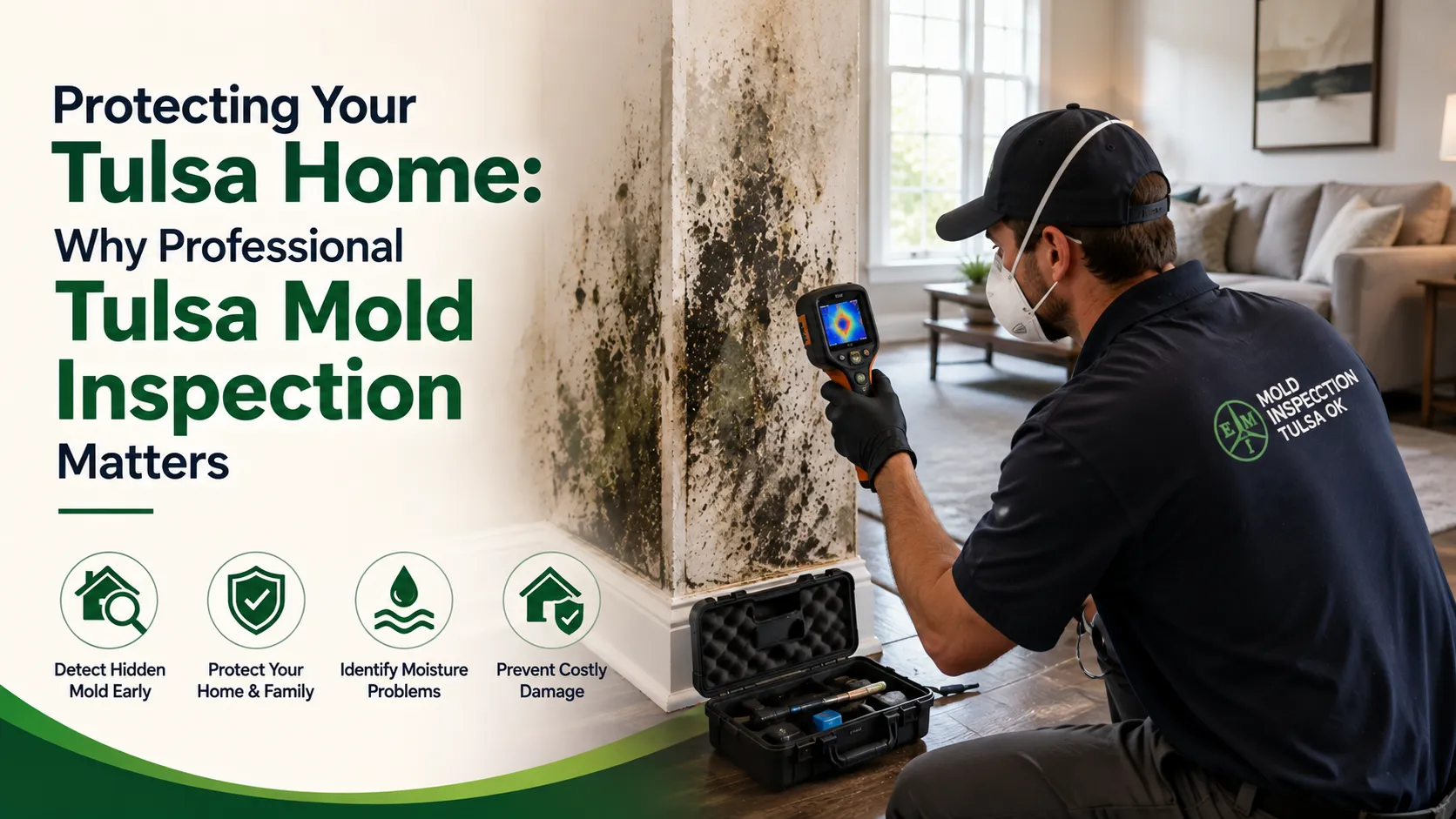
Mold is a natural part of our environment, breaking down organic matter outdoors. However, indoors, it becomes a destructive force. Tulsa experiences hot, humid summers and damp springs, creating a perfect storm for spores to germinate. Consequently, building materials like drywall, insulation, and wood framing act as buffets for these microorganisms. Furthermore, modern construction practices often seal homes tightly for energy efficiency, trapping moisture vapor inside. Without adequate ventilation, condensation forms inside wall cavities, fueling colonies that remain invisible for months. Therefore, understanding the local climate drivers is the first step in proactive property maintenance.
Health Implications You Cannot Ignore
Exposure to elevated indoor spore levels affects individuals differently. Some people experience immediate allergic reactions, including sneezing, itchy eyes, and skin rashes. Others may develop chronic respiratory issues, such as asthma exacerbation or hypersensitivity pneumonitis. In addition, certain species produce mycotoxins, which are toxic secondary metabolites linked to neurological symptoms and immune suppression. Children, the elderly, and immunocompromised individuals face the highest risk. Because symptoms often mimic seasonal allergies, the root cause frequently goes undiagnosed. A thorough assessment connects the dots between the building’s health and the occupants’ well-being.
Red Flags That Demand Immediate Attention
Recognizing the subtle indicators of a problem empowers you to act fast. A persistent earthy or musty smell is often the very first clue, even when zero visible growth exists. Water stains on ceilings or walls indicate a moisture intrusion event that likely seeded spores. Peeling paint or bubbling wallpaper suggests moisture trapped behind the surface. Moreover, recent flooding, roof leaks, or plumbing failures create a ticking clock; colonization can begin within 24 to 48 hours of water exposure. If family members feel better when away from the house, the indoor environment is suspect. Do not wait for black spots to appear on baseboards before calling a professional.
The Science Behind a Professional Mold Inspection Tulsa OK Assessment
A credible evaluation goes far beyond a flashlight and a visual scan. Trained professionals follow standards published by organizations like the IICRC (Institute of Inspection Cleaning and Restoration Certification) and ACAC (American Council for Accredited Certification). They utilize moisture meters to pinpoint dampness inside walls without demolition. Thermal imaging cameras reveal temperature anomalies caused by evaporation, mapping wet zones invisible to the naked eye. Air sampling captures spores onto cassettes for laboratory analysis, identifying genus and concentration levels. Surface swabs or tape lifts confirm active growth on materials. This multi-pronged approach builds a complete picture of the contamination scope.
Why DIY Test Kits Fall Short
Hardware store Petri dishes promise easy answers but deliver misleading data. Gravity settle plates only capture heavy spores falling directly downward, missing the vast majority of airborne particulates. They lack control samples, making it impossible to distinguish normal outdoor infiltration from an indoor reservoir. Furthermore, they cannot identify specific species, many of which look identical to the untrained eye. A “positive” result causes panic; a “negative” result provides false security. Professional labs use calibrated pumps drawing precise air volumes, ensuring statistical validity. Relying on consumer kits wastes critical time and money.
Navigating the Mold Inspection Tulsa OK Process Step by Step
The journey begins with a detailed client interview regarding health symptoms and water damage history. Next, the inspector performs a systematic exterior evaluation, checking grading, gutters, and foundation cracks. Inside, they move room by room, documenting moisture readings and thermal anomalies. Suspect areas trigger targeted sampling strategies. The inspector then interprets lab results, comparing indoor counts to outdoor baselines. A comprehensive report follows, detailing findings, photos, lab data, and a remediation protocol if necessary. This protocol serves as the scope of work for remediation contractors, ensuring everyone bids on the same standard.
Choosing the Right Mold Inspection Tulsa OK Inspector in Green Country
Not all service providers offer the same level of competence. Look for independent third-party inspectors who do not perform remediation themselves. This eliminates a massive conflict of interest where the finder profits from the fix. Verify certifications such as CMI (Certified Microbial Investigator) or CMRS (Certified Mold Remediation Supervisor). Ask for sample reports to gauge thoroughness and clarity. Check reviews on Google and Angie’s List, focusing on communication and report quality. Ensure they carry errors and omissions insurance. A qualified expert educates you, rather than scaring you into a contract.
Common Problem Areas Unique to Tulsa Architecture
Local housing stock presents specific vulnerabilities. Slab-on-grade foundations often suffer from vapor drive through the concrete, dampening carpet tack strips and bottom plates. Pier-and-beam homes battle high crawl space humidity, especially when vents trap moist air. Attics with insufficient ventilation bake in summer heat, driving condensation onto roof decking during cool nights. Older neighborhoods like Brookside or Maple Ridge feature plaster walls that hold moisture differently than modern drywall. Consequently, an inspector familiar with regional building science spots issues outsiders miss.
The Critical Role of Post-Remediation Verification
Remediation is not complete until verification passes. This step, often called clearance testing, occurs after containment removal but before reconstruction. The inspector returns to visually verify cleanliness and runs air samples inside the contained work area. Results must show spore counts similar to or lower than outdoor air. If counts remain elevated, the remediator must re-clean at their own expense. Skipping this step leaves you with no proof the problem is resolved, complicating future real estate transactions. Insist on independent verification written into your remediation contract.
Insurance Claims and Real Estate Transactions
Mold coverage varies wildly between policies. Most standard homeowner policies exclude fungal growth unless it results from a “covered peril” like a sudden pipe burst. Gradual leaks or humidity issues are typically denied. A professional report provides the documentation needed to argue coverage for sudden events. During real estate deals, a clean inspection report is a powerful selling tool. Conversely, buyers use findings to negotiate price reductions or seller-paid remediation. In Tulsa’s competitive market, transparency builds trust and prevents deals from collapsing at the closing table.
Preventative Maintenance Strategies for Homeowners
Prevention is infinitely cheaper than cure. Maintain indoor relative humidity between 30% and 50% using whole-house dehumidifiers or portable units. Ensure bathroom and kitchen exhaust fans vent outdoors, not into the attic. Clean gutters quarterly to prevent overflow onto fascia and soffits. Grade soil away from the foundation at a 5% slope for at least six feet. Inspect washing machine hoses and water heater connections annually. Seal windows and doors to stop wind-driven rain intrusion. These habits create an environment hostile to spores.
Cost Factors and Budget Planning
Inspection fees depend on square footage, sample count, and accessibility. Inspection pricing depends on square footage, sample count, and accessibility. Call (918) 268-5526 for a flat-fee quote that includes lab fees and report generation. Commercial properties or large estates command higher fees due to complexity. While cost matters, the cheapest quote often signals minimal sampling or rushed reporting. Investing in a thorough baseline assessment prevents the far greater expense of incomplete remediation. Request a flat-fee quote inclusive of lab fees and report generation to avoid surprises.
Debunking Persistent Myths
Misinformation spreads faster than spores. Bleach does not kill roots on porous materials; it merely bleaches the color, leaving hyphae intact to regrow. “Toxic black mold” (Stachybotrys) is rare and requires constant saturation, yet media hype makes it the boogeyman. All molds pose allergenic potential at high concentrations. Painting over growth encapsulates moisture, leading to recurrence. UV lights in HVAC systems help but cannot remediate established colonies in ductwork. Education remains your best defense against predatory sales tactics.
How long does a typical residential mold inspection take in Tulsa?
A standard residential assessment usually takes between two and four hours on-site. The duration depends on the home’s square footage, the number of sampling locations required, and the complexity of access to attics or crawl spaces. Larger properties or those with multiple moisture intrusion points may require a full day. The inspector needs sufficient time to conduct thermal scanning, moisture mapping, and client interviews without rushing the process.
Is it safe to stay in my home during the inspection process?
Yes, the inspection process is non-invasive and poses no health risk to occupants. Inspectors do not disturb colonies during a standard assessment; they measure conditions and collect air samples using quiet pumps. However, if visible growth is extensive, the inspector may recommend limiting time in affected rooms until remediation occurs. You will receive immediate verbal findings, with the full written report following within three to five business days after lab analysis.
What is the difference between a mold inspection and a mold test?
An inspection is a comprehensive visual and diagnostic evaluation of the building envelope, moisture sources, and ventilation systems. Testing refers specifically to the collection of air or surface samples for laboratory analysis. A thorough inspection always includes testing, but testing alone without the contextual inspection data is scientifically useless. You need the building science context to interpret what the lab results actually mean for your specific property.
Can a home inspector perform a mold inspection during a standard pre-purchase exam?
Standard home inspectors are generalists trained to identify visual red flags, not microbial specialists. They typically lack the equipment, certifications, and Errors & Omissions coverage for fungal assessments. Most Tulsa home inspection contracts explicitly exclude environmental hazards. If a general inspector notes “fungal-like growth,” you should hire a qualified microbial investigator for a definitive evaluation before closing. This specialty inspection protects your earnest money and future health.
What should I do immediately if I find water damage in my Tulsa home?
Stop the water source immediately, whether that means shutting off the main valve or tarping a roof leak. Begin extraction and drying within 24 hours using fans and dehumidifiers. Remove wet carpet padding and cut drywall at least 12 inches above the water line. Document everything with photos and video for insurance. Then, schedule a professional assessment to verify drying goals are met and no hidden colonization has begun. Speed is the single most critical factor in preventing a minor leak from becoming a major project.
FAQs About Mold Inspection Tulsa OK
When should I schedule a mold inspection Tulsa OK?
Schedule a mold inspection Tulsa OK after any water damage event, before buying or selling a home, or when you notice musty odors or unexplained allergy symptoms. Colonization can begin within 24 to 48 hours of moisture intrusion, so early detection saves thousands in repair costs. Acting fast is always the safer choice.
What areas does a mold inspection Tulsa OK cover?
A professional mold inspection Tulsa OK covers attics, crawl spaces, basements, HVAC components, and every accessible interior room. Inspectors use moisture meters and thermal imaging to find hidden dampness behind walls and under floors. This thorough approach ensures no affected zone is missed.
Is a mold inspection Tulsa OK accurate enough to trust?
Yes. A professional mold inspection in Tulsa OK uses calibrated air sampling pumps, surface swabs, and accredited laboratory analysis, which is far more reliable than DIY test kits. Results are compared against outdoor baseline samples, giving you a scientifically valid picture of your indoor environment.
Do I need mold testing along with my mold inspection Tulsa OK?
Testing is an essential part of any credible mold inspection Tulsa OK, because visual checks alone cannot measure spore concentrations or identify species. Air and surface samples confirm whether growth is active and guide the remediation plan. Call (918) 268-5526, open 24 hours, to schedule your assessment.
Ready for Peace of Mind?
Don’t let hidden moisture threaten your family’s health or your home’s value. Schedule a comprehensive assessment with a local mold expert today.
Open 24 hours. Call (918) 268-5526 anytime, 24/7 emergency service.
Final Thoughts on Safeguarding Your Investment
Your home represents your largest financial asset and your family’s sanctuary. Tulsa’s climate demands vigilance against moisture intrusion. A professional evaluation provides the data-driven roadmap needed to maintain a healthy indoor environment. By understanding the science, recognizing the warning signs, and partnering with an independent qualified expert, you transform uncertainty into actionable knowledge. Proactive management today prevents catastrophic loss tomorrow. Take the first step toward a safer, healthier living space by scheduling your assessment this season.
Helpful resources: For more information, see EPA guidelines on mold.