When a pipe bursts at 2:00 AM or a flash flood overwhelms your basement, every minute counts. Finding reliable Water Damage Cleanup in Tulsa Oklahoma isn’t just about removing standing liquid; it is about protecting your property’s structural integrity and your family’s health. Consequently, immediate action prevents secondary destruction like mold growth and material warping. This guide walks you through the critical steps, costs, and selection criteria for professional mitigation services in the Green Country region.
🔑 Key Takeaways
- Speed is everything: Mitigation must begin within 24–48 hours to prevent microbial amplification.
- Categories matter: Category 1 (clean), Category 2 (grey), and Category 3 (black) dictate safety protocols and disposal requirements.
- IICRC certification is non-negotiable: Verify technicians hold current Institute of Inspection Cleaning and Restoration Certification credentials.
- Document everything: Photos, videos, and written logs are essential for a smooth insurance claim process.
- Local climate drives risk: Tulsa’s severe storms, freezing winters, and aging infrastructure create year-round vulnerability.
The Critical First Hours: Emergency Response in Tulsa
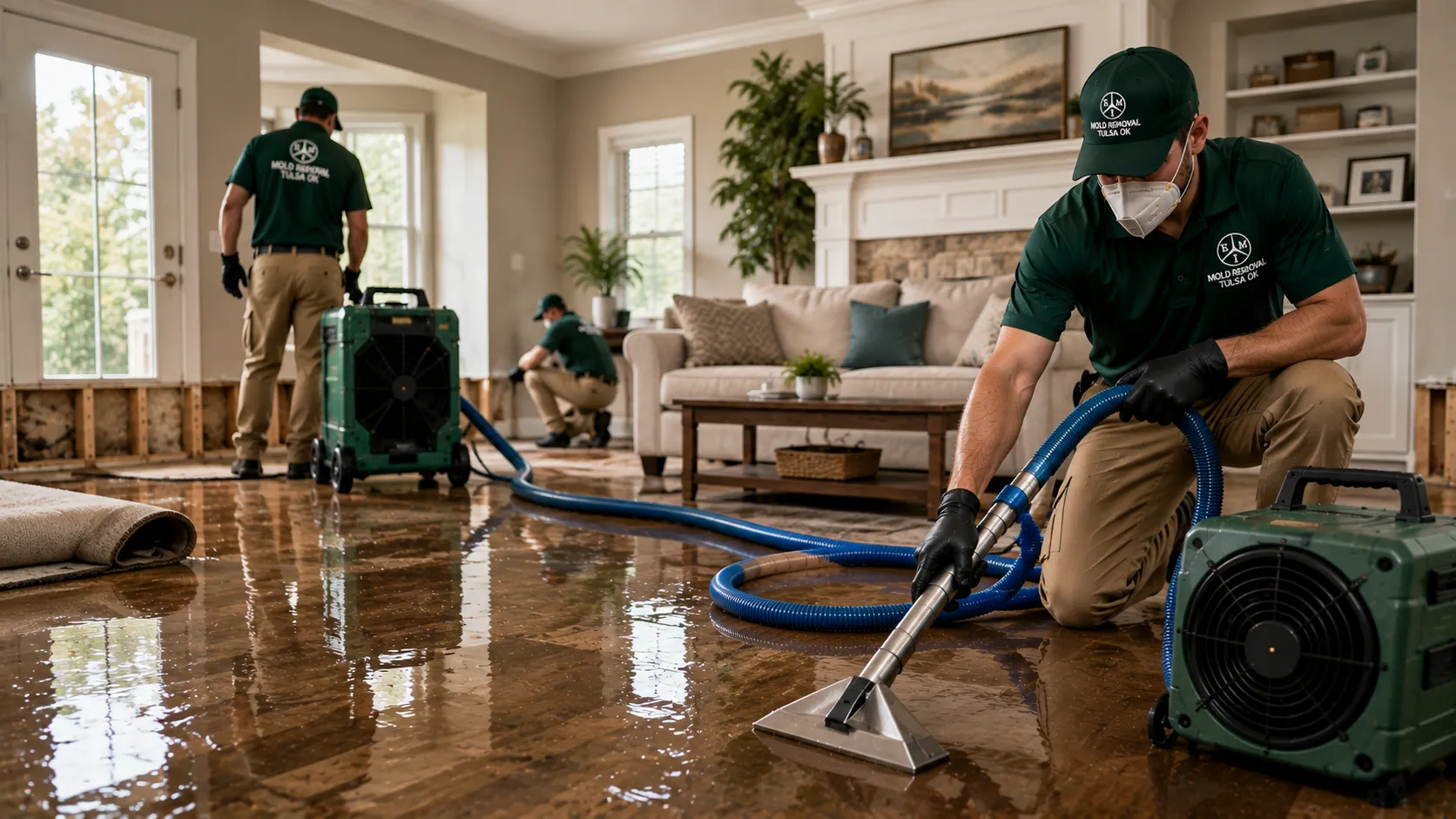
Disaster rarely strikes during convenient business hours. Therefore, the most reputable mitigation firms in the area offer true 24/7/365 emergency dispatch. When you call, a project manager should arrive on-site typically within 60 to 90 minutes. Furthermore, this rapid mobilization limits the migration of moisture into drywall, insulation, and subflooring.
Upon arrival, the crew performs a thorough assessment using infrared thermal imaging cameras and penetrating moisture meters. Consequently, they map the “wet zone” far beyond what the eye can see. This moisture mapping dictates the drying strategy and equipment calculation. Without this data-driven approach, technicians risk under-drying the structure, leading to costly callbacks later.
Understanding the Categories and Classes of Loss
Not all flooding events are created equal. The IICRC S500 Standard classifies contamination levels, and this classification directly impacts the cleanup protocol. Therefore, understanding these distinctions helps you communicate effectively with your restoration provider and insurance adjuster.
Category 1: Sanitary Water
This originates from a clean source like a broken supply line, sink overflow, or rainwater intrusion. It poses no substantial risk from dermal contact or ingestion. However, if left untreated for 48 hours, it degrades into Category 2. Consequently, rapid extraction and drying are still mandatory.
Category 2: Grey Water
This contains significant contamination and potential discomfort or sickness if contacted or consumed. Sources include dishwasher discharge, washing machine overflow, or toilet bowl overflows (urine only). Furthermore, carpet padding usually requires removal and disposal because it acts as a sponge for bacteria.
Category 3: Black Water
This is grossly unsanitary, containing pathogenic agents. Sources include sewage backups, flooding from rivers (like the Arkansas River), or standing water that has supported microbial growth. Consequently, porous materials like drywall, carpet, and insulation must be removed. Technicians must wear full PPE, including respirators, and apply biocides.
Class of Damage (Evaporation Load)
Beyond contamination, the “Class” defines the volume of water and anticipated evaporation rate. Class 1 affects a small area with low porosity materials. Conversely, Class 4 involves deep saturation of low-permeance materials like hardwood, plaster, or concrete, requiring specialized low-humidity drying techniques.
The Professional Mitigation Process Step-by-Step
A standardized workflow ensures nothing is missed. Reputable firms follow the IICRC S500 workflow rigorously. Therefore, you should expect the following sequence during your project.
1. Emergency Contact and Dispatch
The process begins with your call. The dispatcher gathers critical info: source of loss, affected areas, electricity status, and safety hazards. Consequently, the responding crew arrives prepared with the right extractors and safety gear.
2. Inspection and Moisture Mapping
Technicians use thermal imaging to trace migration paths. They check behind baseboards, under cabinets, and inside wall cavities. Furthermore, they establish a “dry standard” by measuring moisture content in unaffected materials in the same environment. This benchmark defines the drying goal.
3. Bulk Water Extraction
Submersible pumps and truck-mounted extractors remove the vast majority of standing liquid. This physical removal is 1,200 times more efficient than evaporation alone. Therefore, thorough extraction dramatically reduces overall drying time and cost.
4. Controlled Demolition (If Necessary)
For Category 2 or 3 losses, or when materials are non-salvageable, crews perform “flood cuts” (removing drywall 12–24 inches above the water line). Additionally, they remove wet insulation, vapor barriers, and compromised flooring. This opens cavities for airflow.
5. Drying and Dehumidification
High-velocity air movers create evaporation at the wet surface. Simultaneously, low-grain refrigerant (LGR) dehumidifiers or desiccant units pull moisture from the air. Technicians monitor progress daily, adjusting equipment placement based on psychrometric readings. Consequently, the environment is driven toward the established dry standard.
6. Cleaning, Sanitizing, and Deodorization
Once dry, HEPA vacuuming removes settled spores and dust. Antimicrobial treatments are applied to framing and subfloors. Furthermore, hydroxyl generators or ozone machines may neutralize persistent odors without masking agents.
7. Reconstruction and Build-Back
Many full-service firms handle the build-back phase: hanging new drywall, installing trim, painting, and replacing flooring. This single-point accountability streamlines the project timeline significantly. However, you retain the right to hire your own contractor for this phase.
What Drives the Cost of Restoration in Green Country
Pricing varies wildly based on the factors above. However, most Tulsa-area jobs fall into general tiers. Insurance typically covers sudden and accidental events, but maintenance-related issues (slow leaks) are often denied. Therefore, understanding cost drivers helps you evaluate estimates.
- Category of Water: Cat 3 jobs cost 3–5x more than Cat 1 due to PPE, disposal, and biocide protocols.
- Affected Square Footage: Larger migration zones require more equipment days.
- Material Types: Hardwood floor drying (Class 4) requires specialty mat systems, increasing equipment rental fees.
- Accessibility: Crawlspaces, tight attics, or high-rise units increase labor hours.
- Time to Response: Delayed mitigation expands the affected area exponentially.
Always request a detailed, line-item estimate written in Xactimate format. This is the industry-standard estimating software used by adjusters. Consequently, an Xactimate estimate speaks the same language as your insurance carrier, reducing friction during claim settlement.
Hidden Moisture and Mold Prevention
Tulsa’s humid subtropical climate creates a perfect incubator for mold. Spores germinate at 60% relative humidity on organic food sources (paper-facing drywall, wood). Therefore, the drying goal is not just “dry to touch” but reaching a specific Equilibrium Moisture Content (EMC). Professional verification uses moisture meters calibrated for specific wood species. Furthermore, post-remediation verification (PRV) by a third-party indoor environmental professional (IEP) provides clearance documentation for future real estate transactions.
Navigating Insurance Claims for Tulsa Homeowners
Filing a claim can feel adversarial, but it doesn’t have to be. Your restoration contractor acts as your advocate. They speak the language of “scope of loss” and “like kind and quality.” Consequently, they ensure the adjuster’s scope matches the actual required repairs.
Key steps for a smooth claim:
- Mitigate further damage immediately (tarp roof, shut off main water). Policies require this.
- Document the source and damage extensively before any removal begins.
- Do not sign a “Direction to Pay” or Assignment of Benefits (AOB) without legal review. These transfer your claim rights to the contractor.
- Request the adjuster’s report and compare it line-by-line with your contractor’s Xactimate estimate.
- Understand your policy limits: “Water Backup” endorsements are often separate from standard dwelling coverage and have lower sub-limits.
Choosing the Right Restoration Partner: Certifications & Red Flags
The industry is unregulated in Oklahoma regarding state licensing for water mitigation specifically. Therefore, third-party certifications are your primary quality filter.
Must-Have Credentials
- IICRC Firm Registration: The company is registered; verify the number on the IICRC website.
- IICRC Certified Technicians: Look for WRT (Water Restoration Technician) and ASD (Applied Structural Drying) badges on the crew.
- General Liability & Pollution Insurance: Minimum $1M/$2M. Pollution coverage is critical for mold/bacteria liability.
- Workers’ Compensation: Protects you if a worker is injured on your property.
Red Flags to Avoid
- High-pressure sales tactics demanding immediate contract signing.
- Unmarked vehicles or lack of uniforms/ID badges.
- Refusal to provide a written scope/estimate before starting.
- Suggesting you “don’t need to involve insurance” for a large loss.
- Inability to explain the psychrometric science behind their drying plan.
Local Climate Challenges: Why Tulsa Homes Are Vulnerable
Tulsa sits in a unique geographical crossroads. Consequently, properties face a trifecta of water threats throughout the year.
Spring Severe Weather Season
April through June brings supercell thunderstorms, hail, and tornadoes. Wind-driven rain exploits roof flashing failures and window seals. Furthermore, hail damage to roofing shingles creates delayed leaks that appear weeks later. Rapid response teams are stretched thin during widespread events, making pre-vetted contractor relationships invaluable.
Winter Freeze Events
While winters are generally mild, Arctic blasts (like the 2021 deep freeze) cause catastrophic pipe bursts in uninsulated attics, crawlspaces, and exterior walls. Copper and PEX pipes split under pressure. Consequently, knowing your main water shutoff location is the single most effective damage limiter.
Aging Infrastructure and Clay Soils
Many Tulsa neighborhoods (Midtown, Brookside, Maple Ridge) feature homes built 50–100 years ago. Galvanized plumbing reaches end-of-life, corroding from the inside out. Additionally, expansive clay soils shift seasonally, stressing foundation slabs and sewer laterals, leading to slab leaks and sewer backups.
Frequently Asked Questions
How quickly does mold start growing after water damage in Tulsa?
Mold colonization can begin within 24 to 48 hours in Tulsa’s humidity. Spores are ubiquitous; they only need moisture, a food source (drywall paper, dust), and the right temperature. Consequently, professional drying targets the “critical 48-hour window” to prevent amplification. If materials remain wet beyond 72 hours, industry standards assume microbial growth has started, triggering Category 2/3 protocols.
Will my homeowners insurance cover the cost of water damage cleanup?
Most standard HO-3 policies cover “sudden and accidental” discharge (burst pipes, appliance failure). However, they typically exclude gradual leaks, flood (rising ground water), and sewer backup unless a specific endorsement is purchased. Furthermore, your deductible applies. A reputable restoration contractor will help you determine coverage viability before committing to non-emergency work.
Can I stay in my home during the drying process?
It depends on the Category and affected areas. For Category 1 losses confined to one room, occupancy is usually fine. However, Category 2/3 losses, or projects requiring heavy equipment noise (air movers hit 60-70 decibels) and containment barriers in living spaces, often necessitate temporary relocation. Additionally, if asbestos or lead paint is disturbed during demolition, strict containment makes occupancy unsafe.
What is the difference between a mitigation company and a general contractor?
A mitigation company specializes in emergency stabilization: extraction, drying, and microbial prevention. They use scientific drying principles (psychrometrics). A general contractor specializes in reconstruction (build-back): framing, drywall, paint, flooring. Many firms in Tulsa offer both divisions. However, verify the mitigation team holds IICRC certifications separately from the builder’s license.
How do I prevent frozen pipe bursts in my Tulsa attic or crawlspace?
Insulate exposed piping with foam sleeves or heat tape (UL listed). Seal air leaks in the crawlspace or attic where cold wind hits pipes. Keep garage doors closed if supply lines run through there. During deep freezes, let faucets drip slowly to relieve pressure. Furthermore, install a smart water leak detector with automatic shutoff valve on your main line for ultimate protection.
Don’t Let Water Win. Act Now.
Every hour of delay increases repair costs and health risks. Our IICRC-certified teams are standing by 24/7 with truck-mounted extractors and thermal imaging technology.
Call Emergency Dispatch: (918) 268-5526
Free Moisture Assessment • Insurance Claim Assistance • Licensed & Insured
Helpful resources: For more information, see EPA guidelines on mold and FEMA disaster recovery resources.