
When a pipe bursts at 2 a.m. or a flash flood overwhelms your basement, every minute counts. Finding reliable water damage restoration near Tulsa Ok becomes the single most urgent priority for a homeowner. Standing water seeps into subfloors, warps hardwood, and invites toxic mold growth within 24 to 48 hours. Consequently, a rapid response is not merely convenient; it is essential for preserving structural integrity and indoor air quality. This guide walks you through the critical steps, local risks, and professional standards that define a successful recovery.
Key Takeaways
- Speed is critical: Mitigation must begin within hours to prevent secondary mold damage.
- Category matters: Clean water, gray water, and black water require vastly different safety protocols.
- Local expertise wins: Tulsa’s clay soil and weather patterns create unique foundation and drainage challenges.
- Insurance navigation: Reputable firms document everything to maximize your claim payout.
- IICRC certification: Always verify technicians hold Institute of Inspection Cleaning and Restoration Certification credentials.
Understanding the Tulsa Climate Risk Factor
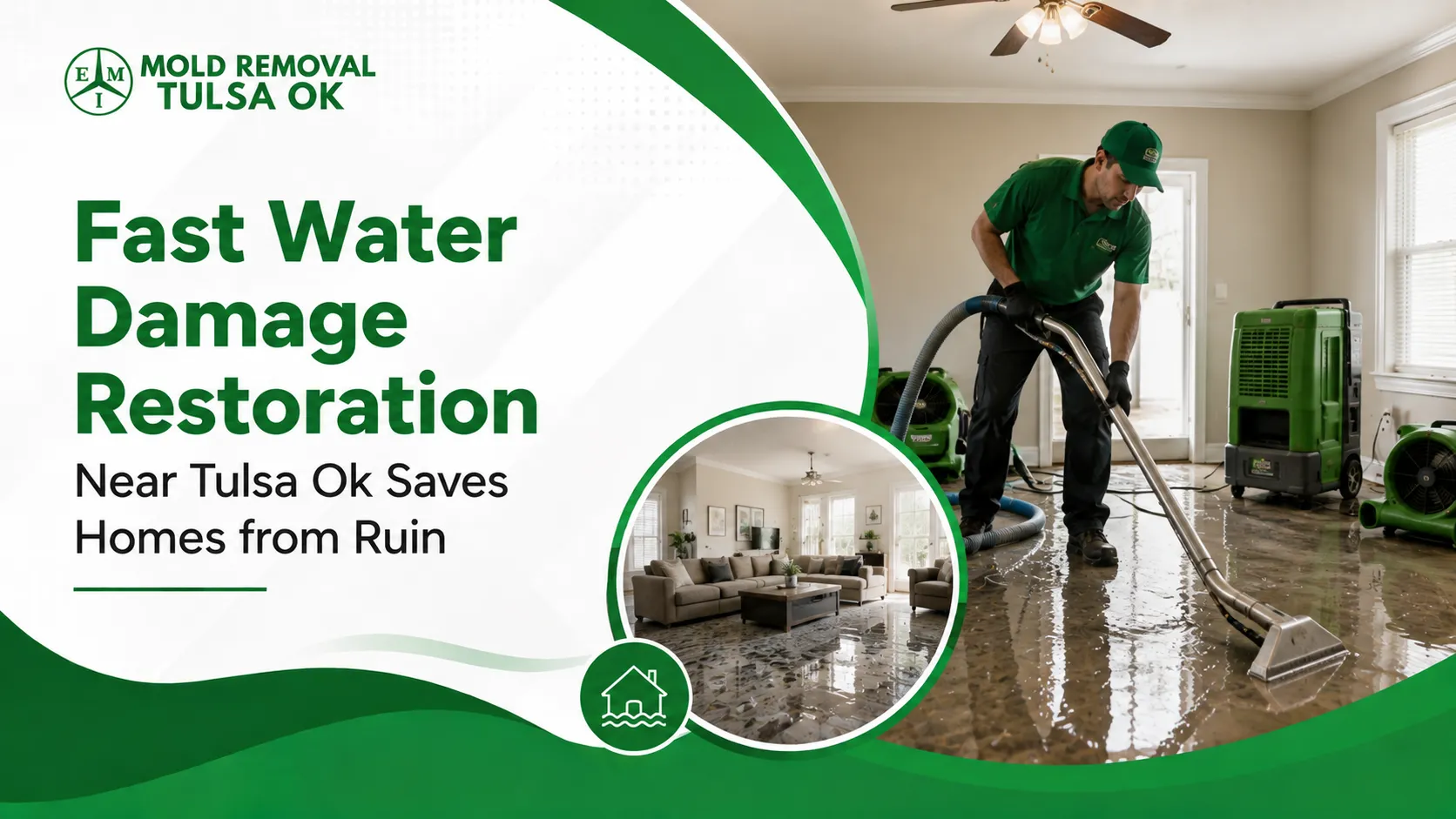
Tulsa sits in a unique geographical zone where severe weather strikes frequently. Spring brings torrential downpours and hailstorms. Summer heat bakes the expansive clay soil, causing foundation shifts that crack plumbing lines. Winter freezes burst uninsulated pipes in crawlspaces. Therefore, local restoration crews understand these specific failure points better than national chains. They anticipate the hidden moisture pockets behind brick veneer and inside pier-and-beam foundations common in midtown neighborhoods.
Furthermore, the Arkansas River watershed creates flash flood zones that FEMA maps update regularly. Homes near Cherry Creek or Joe Creek face elevated risks. Consequently, a crew familiar with local floodplain management regulations ensures your rebuild meets current code requirements. This local knowledge prevents costly permit delays during the reconstruction phase.
The Science Behind Professional Mitigation
Inspection and Moisture Mapping
Technicians arrive with thermal imaging cameras and penetrating moisture meters. They do not guess where water traveled; they map it. Infrared sensors detect temperature differentials behind walls. Moisture meters quantify saturation levels in drywall, insulation, and structural framing. This data creates a drying blueprint. Without it, crews might miss a wet header beam above a window, leading to rot months later.
Water Classification Dictates Protocol
The IICRC S500 standard defines three categories. Category 1 originates from a sanitary source like a supply line. Category 2 contains significant contamination, such as dishwasher overflow or washing machine discharge. Category 3 is grossly unsanitary, including sewage backups or rising floodwater. Each category demands specific personal protective equipment (PPE) and antimicrobial treatments. Therefore, misclassifying a loss to save money creates massive liability and health hazards.
Extraction and Evaporation Dynamics
Powerful truck-mounted extractors remove bulk water at rates exceeding 300 gallons per minute. Portable units reach upper floors. After extraction, the physics of evaporation takes over. Air movers create high-velocity airflow across wet surfaces. This boundary layer disruption accelerates moisture release into the air. Simultaneously, commercial dehumidifiers pull that vapor from the atmosphere. Consequently, the environment reaches equilibrium faster, stopping microbial amplification.
Why DIY Drying Fails Most Homeowners
Renting a carpet cleaner and box fans seems economical. However, surface drying masks deep saturation. Water migrates upward through capillary action in drywall, often rising two feet above the visible water line. Standard fans lack the static pressure to push air into wall cavities. Moreover, without refrigerant or desiccant dehumidification, the evaporated moisture simply condenses on cooler surfaces elsewhere. This secondary condensation damages unaffected rooms. Professional crews create containment chambers to control vapor pressure differentials, ensuring moisture exits the structure entirely.
Navigating the Insurance Claim Maze
Adjusters represent the carrier, not the policyholder. A restoration advocate levels the playing field. They provide detailed line-item estimates using Xactimate software, the industry standard pricing database. They photograph every affected material before removal. They log psychrometric readings (temperature, humidity, grain count) daily to prove drying progress. This documentation forces the insurer to honor the policy limits. Furthermore, many local firms offer direct billing, so you pay only the deductible. This cash-flow relief is vital during displacement.
Mold Prevention: The 72-Hour Window
Mold spores exist everywhere. They need moisture, a food source (paper, dust, wood), and time. Colonization begins at 48 hours; visible growth appears at 72. Consequently, antimicrobial application is standard on Category 2 and 3 losses. On Category 1, it is applied if drying exceeds 72 hours. HEPA air scrubbers run continuously during demolition to capture aerosolized spores. Negative air pressure containment prevents cross-contamination to clean zones. Post-remediation verification by a third-party industrial hygienist provides clearance certification. This document protects future resale value.
Structural Drying vs. Demolition Decisions
Not everything wet must go. The “dry in place” methodology saves thousands. Hardwood floors dried with specialized mat systems often survive. Drywall dried within 48 hours retains structural integrity. However, insulation batts lose R-value when wet and rarely dry fast enough; they are removed. Baseboards are detached to access wall cavities. Crown molding stays if the wall cavity dries successfully. These nuanced decisions require experience. Aggressive demolition inflates reconstruction costs and extends displacement time unnecessarily.
Reconstruction: From Mitigation to Move-In
Mitigation stabilizes the loss. Reconstruction restores the home. Full-service companies handle both phases seamlessly. This continuity eliminates the “finger-pointing” gap between mitigation contractors and build-back crews. The project manager who dried your subfloor knows exactly where the moisture barrier failed. They specify the correct vapor retarder for Tulsa’s mixed-humid climate zone. They match existing textures, paint sheens, and flooring transitions. Consequently, the finished product looks like the disaster never happened.
Commercial Property Considerations
Business interruption costs dwarf residential displacement. Downtime equals lost revenue, payroll obligations, and potential lease penalties. Commercial projects demand phased drying. Critical operations areas are isolated and dried first. Temporary power and climate control maintain server rooms or inventory storage. Documentation follows stricter standards for business interruption claims. Local firms with commercial division experience coordinate with property managers, risk managers, and corporate adjusters simultaneously.
Choosing the Right Local Partner
Verify licensing with the Oklahoma Construction Industries Board. Check for IICRC firm registration. Read Google reviews focusing on communication and timeline adherence. Ask for references from recent jobs in your specific zip code. A reputable company provides a written scope of work, timeline, and warranty before starting. They explain the “why” behind every charge. Transparency builds trust during a chaotic life event. Therefore, interview two or three firms even during an emergency; the 30 minutes spent vetting saves months of regret.
Preventative Maintenance for Tulsa Homeowners
Install a water leak detection system with automatic shutoff valves. These devices pay for themselves after one prevented catastrophe. Clean gutters quarterly; Tulsa’s oak trees shed massive debris. Extend downspouts at least six feet from the foundation. Grade soil away from the slab. Insulate pipes in unconditioned spaces. Test sump pumps before spring storm season. Schedule annual plumbing inspections for homes over 30 years old. Proactive maintenance is the cheapest restoration strategy available.
How quickly must mitigation begin after a flood?
Mitigation should start immediately, ideally within the first 24 hours. Mold colonization begins at 48 hours, and building materials deteriorate rapidly with prolonged saturation. Most reputable Tulsa crews offer 24/7 emergency dispatch to meet this critical window.
Will my homeowners insurance cover the full cost?
Coverage depends on the water source. Sudden accidental discharge (burst pipe) is typically covered. Gradual leaks or floodwater from rising rivers usually require a separate flood policy. A restoration contractor helps document the cause to support your specific claim classification.
What certifications should I verify before hiring?
Look for IICRC firm certification and individual technician certifications in Water Damage Restoration (WRT) and Applied Structural Drying (ASD). Oklahoma state licensing for general contractors is also required for any rebuild work exceeding $2,000 in labor and materials.
Can I stay in my home during the drying process?
It depends on the contamination category and affected areas. Category 1 losses limited to one room often allow occupancy. Category 2 or 3 losses, or projects requiring heavy equipment noise and air scrubbers in living spaces, usually necessitate temporary relocation for health and comfort.
How long does the entire restoration process take?
Mitigation (drying) typically takes 3 to 5 days. Reconstruction varies wildly: a simple drywall patch and paint takes a week; a full kitchen gut and remodel takes 6 to 12 weeks. Supply chain lead times for cabinets or specialty flooring often dictate the final timeline.
Don’t Let Water Win — Act Now
Every hour of delay increases repair costs and health risks. Our IICRC-certified team stands ready 24/7 with truck-mounted extraction, thermal imaging, and direct insurance billing. We know Tulsa soils, Tulsa codes, and Tulsa weather.
Call Emergency Dispatch: (918) 268-5526
Licensed • Insured • Locally Owned & Operated Since 2008
Helpful resources: For more information, see EPA guidelines on mold and FEMA disaster recovery resources.